
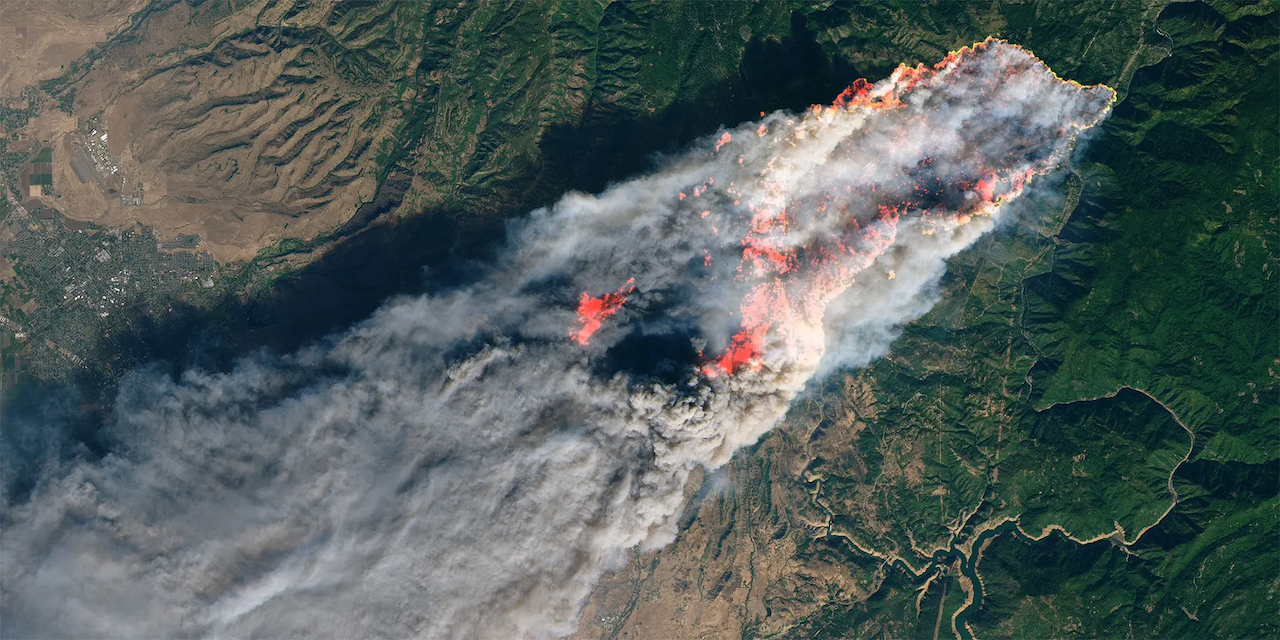
Wildfires are driving emissions in California.
Satellites tracking methane plumes, AI systems monitoring forests in near-real-time, and sensors detecting transportation emissions – these are some of the technology initiatives that have put the U.S. at the forefront of efforts to measure greenhouse gases across natural and human systems.
But recent scientific and technological innovations across public and private institutions must be coordinated and synthesized to generate actionable data for policy and investment decisions.
To address this challenge, CTrees has joined a new coalition of scientists and policy experts to coordinate and accelerate efforts to measure GHGs across multiple sectors in the U.S.
Convened by the Data Foundation, a nonpartisan think tank in Washington, D.C., and its Climate Data Collaborative, the GHG Coalition brings together expertise from government, academia, the private sector, and nonprofits. This technical initiative aligns efforts to measure, monitor, report, and verify (MMRV) GHG emissions and removals in the U.S.
“Leaders across U.S. sectors, including in forestry and land use, are seeking advanced technology and innovative solutions to reduce emissions while tracking health and productivity of their industries,” said Sassan Saatchi, CEO and chief scientist of CTrees. “We are at a pivotal moment, combining our expertise on the ground with space technology and AI to accurately measure the complex dynamics of natural systems like forests. Coordinating with policy experts can accelerate access to GHG data, driving environmental and economic decisions at every scale.”
Saatchi will serve on the coalition’s advisory body, alongside leading policy experts and scientists. The advisory body will guide the coalition’s priorities, including an initial phase focused on coordination and information sharing for the GHG measurement community, and a second phase to develop workstreams to advance science-based solutions.
High-quality GHG measurement tools support climate policy and investment across all sectors. In forestry and land use, emissions and removal data guide forest management and enable sound investment decisions. Governments and communities use GHG data to develop climate action plans, mitigate wildfire risk, and track progress toward their economic goals.
The state of California, for example, added more than 80 targets for nature-based solutions last year to its 2045 carbon neutrality plan, including wildfire risk mitigation in forests, cropland management, urban tree planting, and grassland and chapparal restoration. Implemented locally, these nature-based solutions require advanced data to measure small-scale impacts and assess their cumulative effect on state-wide emissions and removals. Carbon markets, insurance, and land use planning likewise depend on GHG and forest data for accountability and action.
Forest and land use present unique challenges for GHG measurement, as the only sector that both emits and removes carbon. With growing demand to boost removals, and cut emissions from wildfires and land conversion, high-quality data is critical. CTrees provides the only system that annually measures carbon stocks, emissions, and removals in every state and county, along with the nation’s most advanced tree-level mapping platform.
As part of the GHG Coalition, CTrees aims to coordinate its GHG data with other innovative solutions, to build a technical backbone for connecting government and industry MRV needs. Rather than replacing existing efforts, the coalition ensures member organizations work together to maximize the positive impact of GHG information in the U.S.
For further details on the coalition, please visit: www.ghgcoalition.org
To learn more about CTrees’ approach to GHG data, join an expert panel discussion on digital MRV for a U.S. tree-based economy, hosted at the Nature Hub next Wednesday, September 24, as part of Climate Week NYC.


