
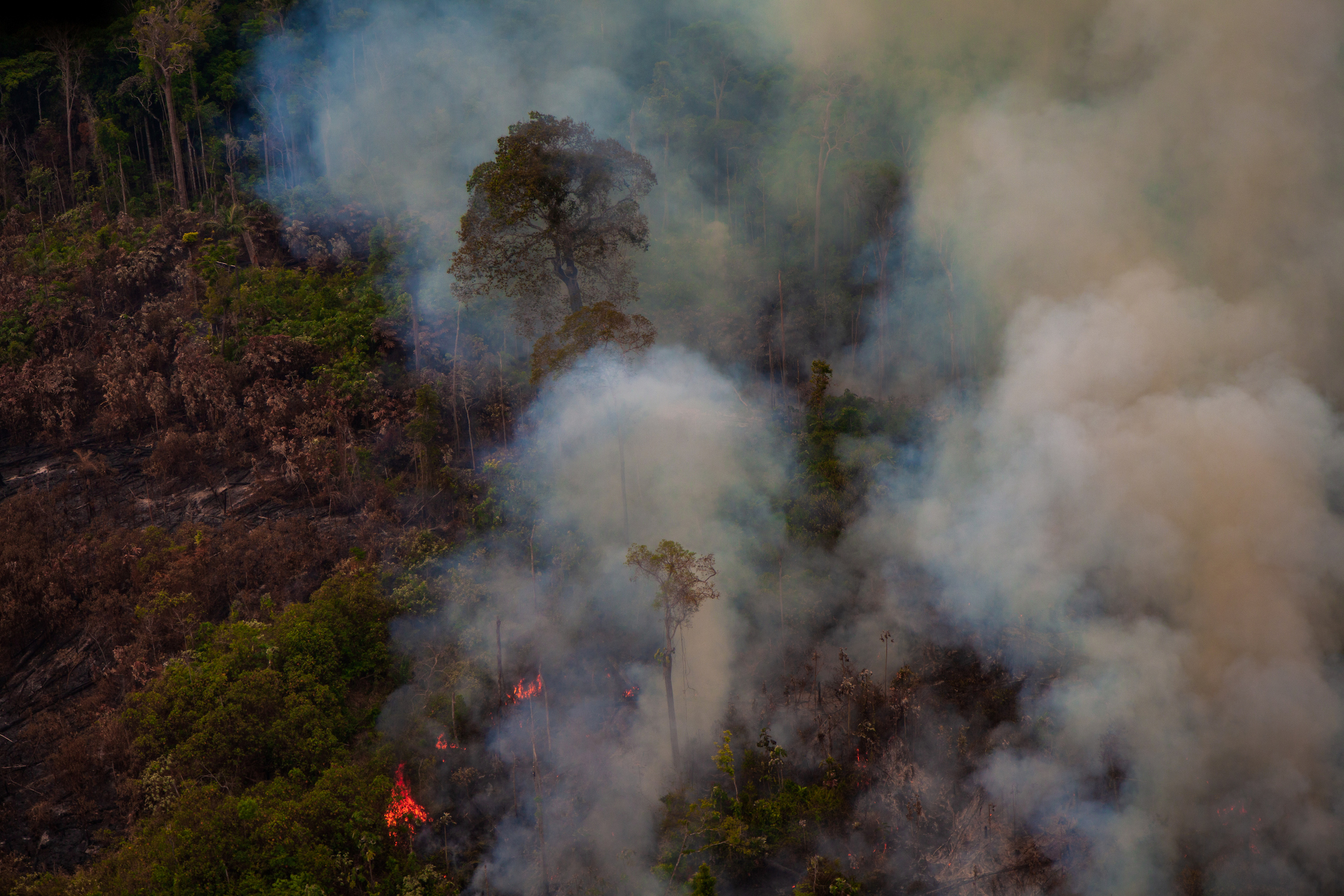
Fire is re-shaping the Amazon Basin ecosystem at an alarming pace, warn scientists in a peer‑reviewed commentary published this week in Nature Communications Earth & Environment (opens in a new tab). Co‑lead authors Manoj Hari and Sassan Saatchi of CTrees, together with prominent Amazon researchers, call for urgent, prevention‑first action by governments, law enforcement, supply‑chain actors, and investors in nature‑based solutions.
The commentary is co-authored by Ane Alencar and Celso H.L. Silva (Amazon Environmental Research Institute, IPAM), Luiz Aragão and Liana Anderson (Brazil’s National Institute for Space Research, INPE), and Paulo Artaxo and Carlos Nobre (University of São Paulo).
The authors document a fundamental shift in the Amazon’s fire regime in recent years, as human activity sparks widespread fires that are now cutting to the core of a forest weakened by drought, heat waves, and deforestation.
From short-term shocks to lasting forest loss
Severe droughts and heat waves are weakening the Amazon forest’s resilience, leaving more trees dead and dramatically increasing fuel loads.
“Burned Amazon forests rarely rebound quickly, with recovery taking decades to a century, so repeated fires are converting once‑intact stands into long‑lasting degraded landscapes,” said Sassan Saatchi, CEO and chief scientist at CTrees.
Widespread deforestation and degradation have also impaired the Amazon forest’s capacity to recycle moisture, reducing regional rainfall and amplifying drying. In a drier, fragmented basin, these coupled feedback loops make fires more frequent and severe, such that the forest cannot fully recover.
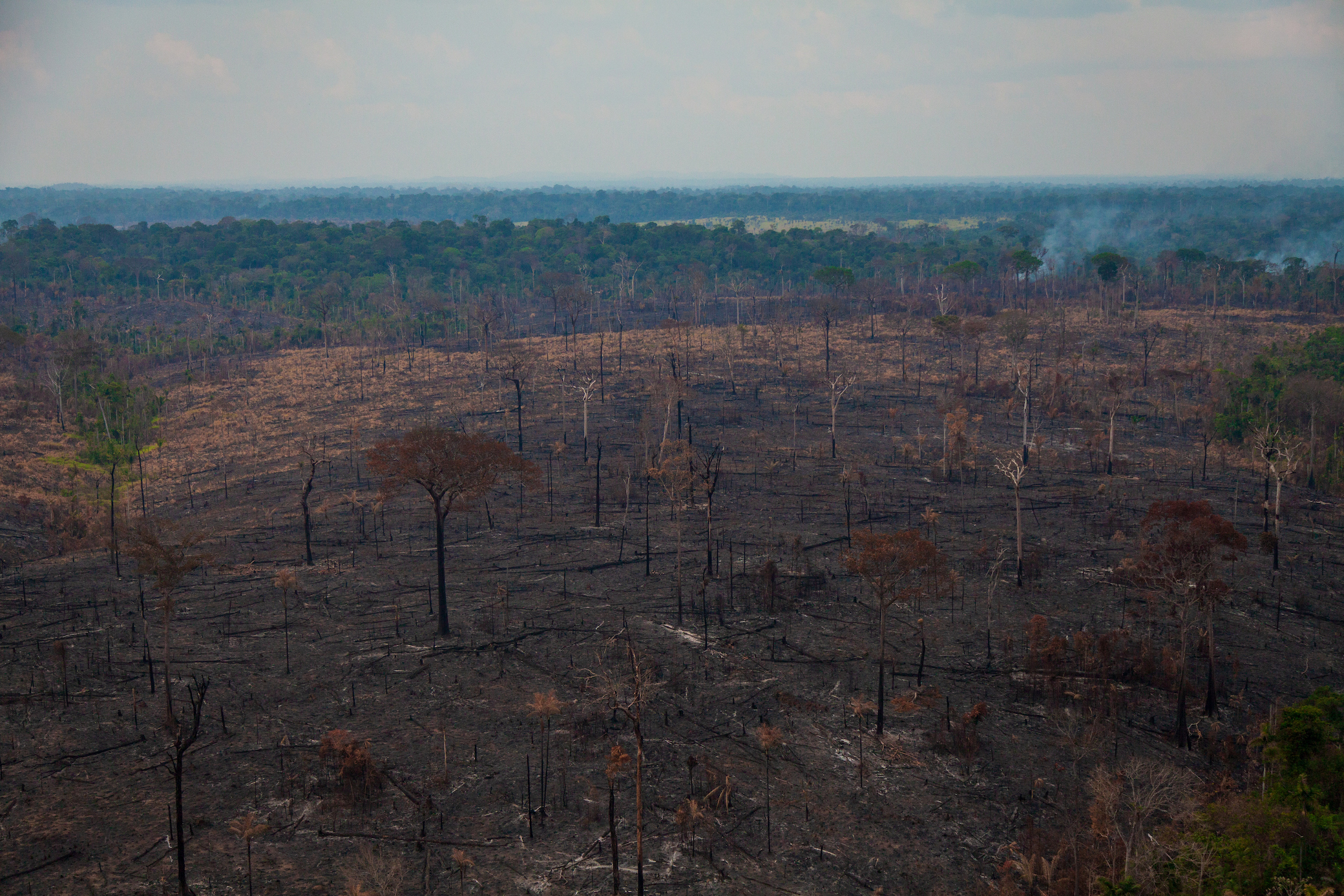
Fires penetrate the interior of forests
Fires are now penetrating intact forest interiors, fueled by hotter, drier conditions and by ignitions that start in pastures, degraded belts, and, during severe drought, within the standing forest itself.
“This is a different fire regime,” said Manoj Hari, CTrees research scientist and lead author. “Fires are no longer just an edge phenomenon tied to clearing; they are now spreading into the core of the forest, enabled by a drier, hotter, and more fragmented landscape and increasing human ignition sources.”
In the first half of 2023, only a fifth of fires coincided with deforestation alerts. Most ignitions started in pasture and degraded forests, then took off in intact forests under hot and dry conditions. In periods of severe drought, a significant fraction of fires are set within forests themselves.
The extent of fire in recent years is such that fire degradation impacts are now overtaking gains in addressing deforestation, the authors warn. In Brazil, the authors note, degradation from fire now affects areas an order of magnitude larger than recent clear‑cut deforestation, and emissions from forest fires are nearly on par with deforestation.
Human activity sparks widespread fires
Ignition in the Amazon is almost entirely caused by human activity. It can occur when farmers burn fields for pasture management or seek to clear trees for land, resulting in accidental escape to vulnerable dry forests nearby. A portion of fires are deliberately set as part of illegal forest clearing and appropriation of land.
While Indigenous Peoples and agricultural landowners have used fire as a local technique to manage landscapes, the risk of fires escaping is now high, as illustrated by extensive burning (opens in a new tab) reported in the Tapajós–Arapiuns Extractive Reserve in Pará in 2023-2024.
“Escaped agricultural burns, deliberate arson and frontier degradation, amplified by human-driven warming and drying, now drive Amazon flammability," said Carlos Nobre, Professor of Climate and Sustainability at the Institute for Advanced Studies at the University of São Paulo (IEA-USP). “That dual human footprint makes prevention both urgent and feasible.”
Orienting policy toward fire prevention
The authors call for immediate, coordinated policy and operational responses that prioritize preventing ignition and limiting fire spread in high-risk areas such as forest edges, previously burned forests, and degraded belts of land. Their recommendations include:
Link rapid forecasts to local action: Use daily/weekly fuel‑moisture and fire‑risk forecasts to trigger zero‑burn alerts, surge brigades, targeted enforcement, and on‑site adjudication.
Add “degradation‑free” to supply‑chain standards: Extend deforestation‑free commitments to penalize fire‑driven degradation, using attribution tools to tie commodity sourcing to fire impacts.
Mandate fire monitoring in MRV: Require near‑real‑time satellite and ground detection of understory fires, selective logging, and edge effects in carbon and nature‑based finance protocols, and link payments to reductions in anomalous fire.
Technology solutions should complement policy and local action: Strengthen tenure and Indigenous stewardship, revoke permits for high‑risk frontier activities, and train farmers in fire‑free land‑management alternatives, while prohibiting use of fire in periods of extreme heat and drought.
Targeted fire prevention works, the authors note. In 2025, coordinated government efforts to prevent forest fire, expand brigades, ban agricultural burns, and tighten supply‑chain oversight, coincided with substantially reduced burning, despite lingering drought recovery. The authors urge scaling these measures now, particularly given forecasts of a strong El Niño that could exacerbate dryness and ignition risk.
The full commentary, “Fire risk mitigation underpins durable Nature-based Climate Solutions in the Amazon,” is available now as an open access article in Nature Communications Earth & Environment (opens in a new tab).


