
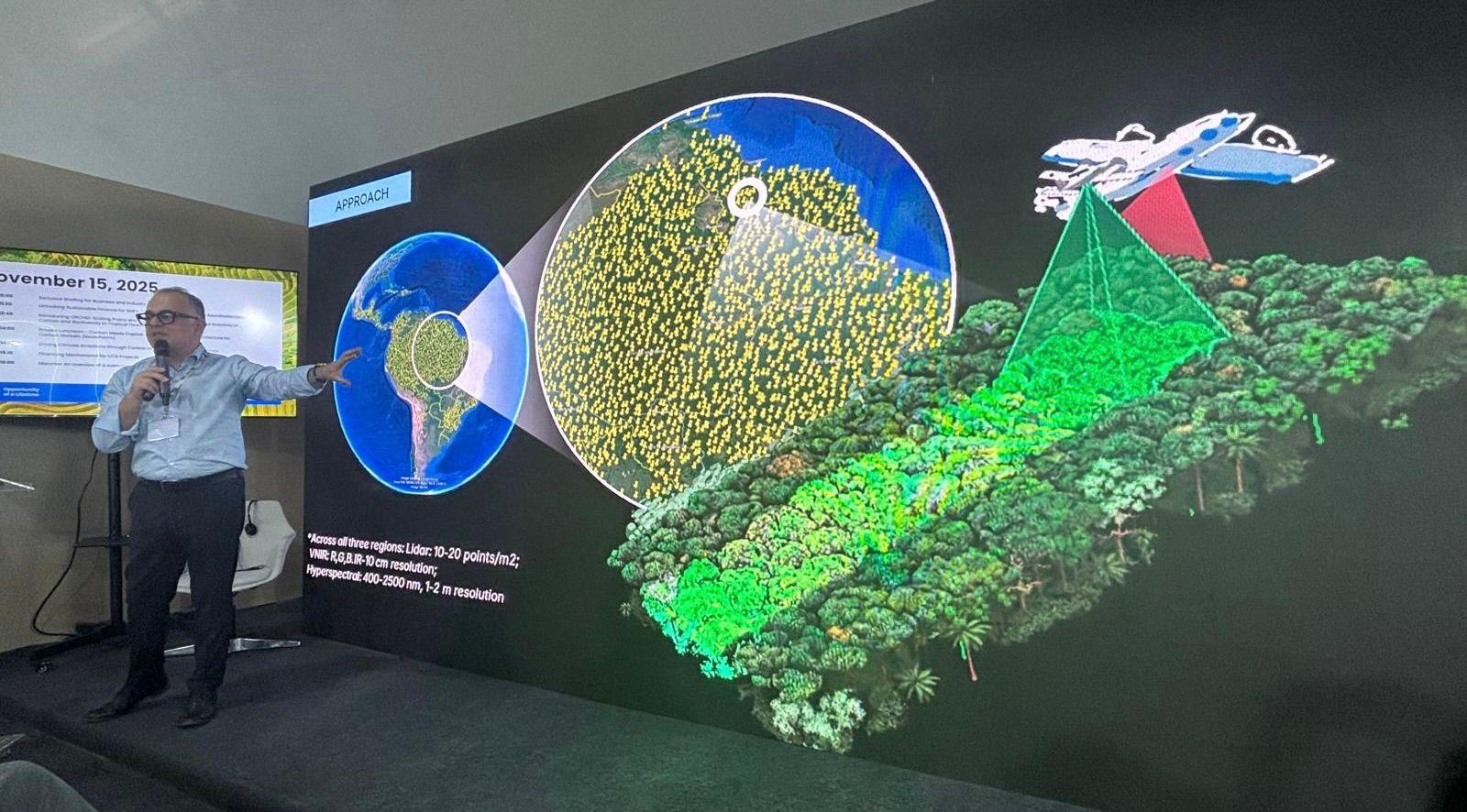
Sassan Saatchi, CTrees’ CEO and chief scientist, shares an illustration of ORCHID’s airborne lidar approach. (Photo credit: Raymond Song)
A critical barrier exists in protecting tropical forests and spurring global climate action. Despite their importance, tropical rainforests remain one of the least understood ecosystems on Earth. Home to over half of all known species and serving as vital carbon sinks, these lush forests face a significant data gap. Current global maps fail to accurately capture small-scale variations in forest structure, such as height and live biomass, at 1-hectare or smaller scales. This is primarily due to limited data on the complex spatial diversity of species composition and wood density, which are crucial for estimating biomass carbon—a key indicator linked directly to biodiversity.
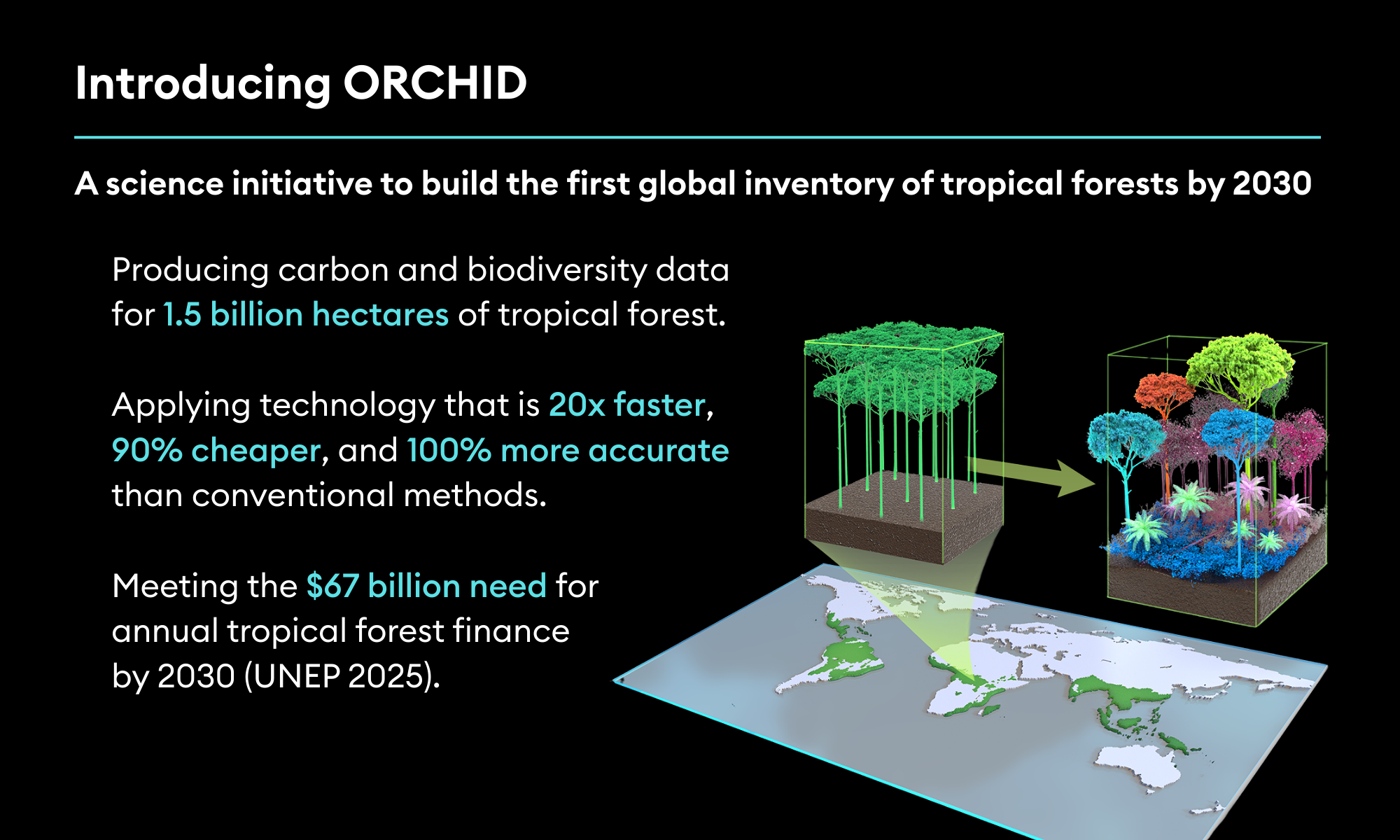
The knowledge gap has led to alarming uncertainties in tropical forest carbon emissions and removals, with uncertainty in current estimates exceeding 200%. Unlike the U.S., where extensive ground-based inventories are conducted every 5 to 10 years across tens of thousands of statistically designed plots, tropical regions lack systematic, reliable data due to access challenges and institutional capacity—covering over 1.5 billion hectares of pristine, often inaccessible ecosystems.
The data deficiency hampers the ability of tropical countries to accurately report their forest stocks, jeopardizing their commitments under nationally determined contributions (NDCs) and undermining confidence in nature-based solutions. As global carbon markets stagnate and the need for forest-based investments must triple by 2030, the world cannot afford continued uncertainty.
In response, CTrees is building a coalition to launch ORCHID (Open-source Rainforest Carbon and Habitat Inventory of Diversity), a pioneering five-year, $100 million initiative to deliver the world’s most comprehensive, accurate, and cost-effective tropical forest inventory, covering over 1.5 billion hectares. By applying cutting-edge technology, ORCHID would deliver inventory data 20 times faster and with 100% more accuracy than traditional methods, at a fraction of the cost.
Designed with an open data infrastructure, and built in collaboration with local scientific institutions, ORCHID will empower tropical nations to lead conservation and climate efforts with confidence. By fostering sovereign governance and inclusivity, ORCHID will shift the balance of power—enabling local communities to access carbon markets and ensuring that tropical ecosystems continue to thrive as vital carbon stores.
At COP30, a distinguished group of scientists and conservation leaders from Central and South America, the Congo Basin, and Southeast Asia gathered to discuss ORCHID and explore the impact this initiative will have on their work. Organized by Sassan Saatchi, CTrees’ CEO and chief scientist, the conversation revealed both the urgent need for better forest data and a shared vision for how ORCHID could address long-standing inequities in climate science and finance by improving confidence in markets for nature-based solutions.
As the panelists emphasized, tropical forests underpin climate stability, biodiversity, and local livelihoods, and yet the global community still lacks a trusted, shared picture of how much carbon tropical forests store, how fast the ecosystems are changing, and their resilience to ongoing climate shifts.
Lydie-Stella Koutika, a co-chair of the Science Panel for the Congo Basin and a senior research scientist in the Republic of the Congo, highlighted that for the Congo Basin—where scientific institutions have lacked the resources of those in the Amazon—ORCHID represents an opportunity to strengthen national expertise, create a community of practice across the region, and ensure that data are available for local universities and agencies.
Koutika stressed that ORCHID’s data governance must recognize the sovereignty of Congo Basin countries over their forest information and must ensure that local scientists have the tools and knowledge to analyze and interpret the data themselves. The theme of local ownership and capacity building for Congo Basin, Amazonian, and Southeast Asian institutions resonated throughout the session.
Speakers from Brazil spoke to the need to unify biodiversity and environmental datasets, and integrate systems that are currently disjointed and inconsistent. Paulo Artaxo, a physicist at the University of São Paulo, emphasized that ORCHID offers a way to link these dimensions by providing consistent maps of biomass, canopy structure, and spectral proxies for biodiversity across large regions.
Ane Alencar, director of science at Amazon Environmental Research Institute (IPAM), emphasized that current monitoring systems capture deforestation more clearly than degradation. ORCHID’s combination of LiDAR and imaging spectroscopy could detect subtle changes in structure and species composition following fire and logging, helping to inform policy design for fire risk management and forest recovery.
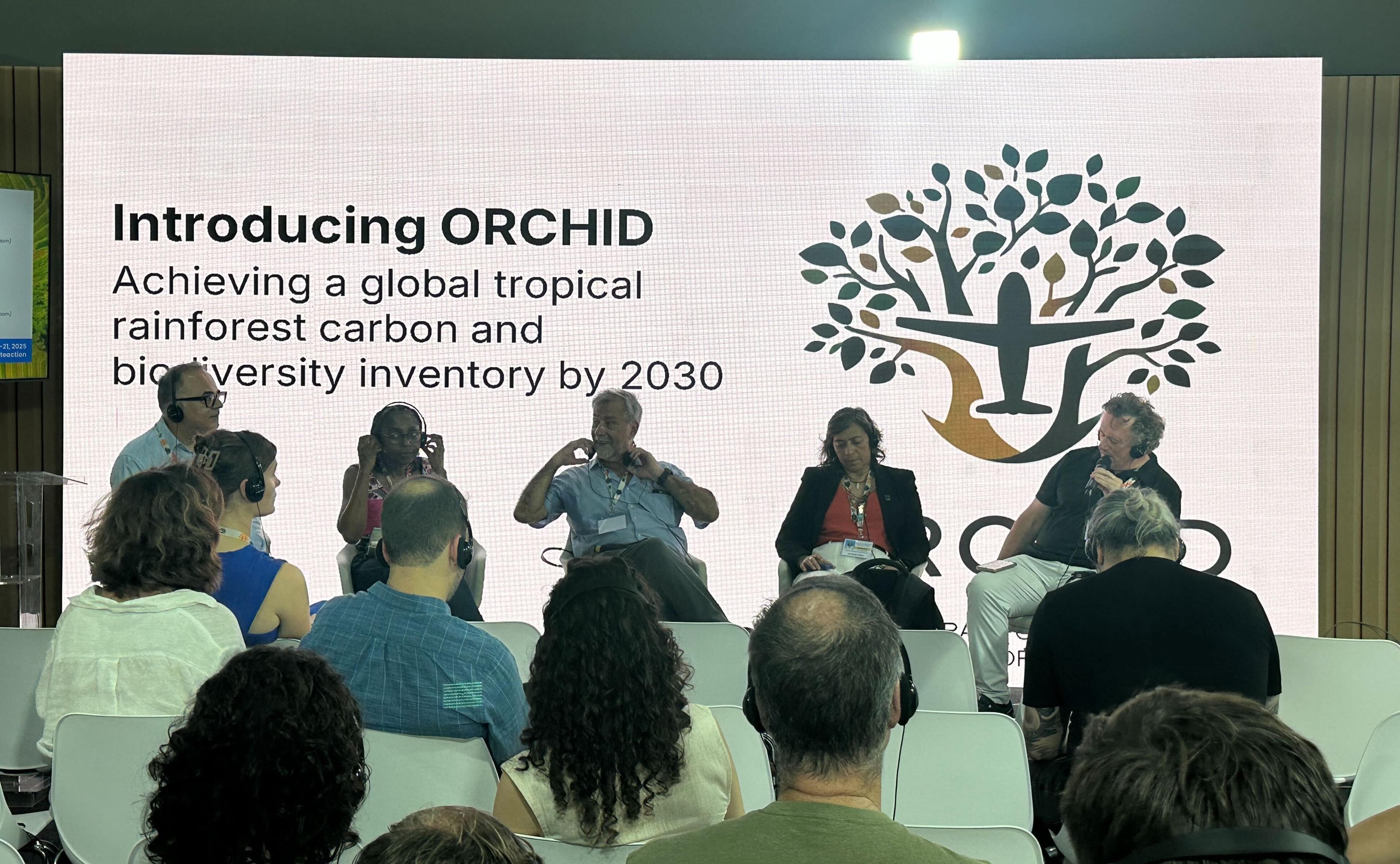
Lee White (right) speaks at an ORCHID event at COP30. (Photo Credit: Raymond Song)
Disputes over data and carbon outcomes have hampered finance for tropical forests at both project and jurisdictional levels in the decade since the Paris Agreement was adopted.
Lee White, special envoy for the Science Panel for the Congo Basin (and a CTrees board member) recalled his experience as environment minister of Gabon, where the country spent years of resources and effort to build national data on forest carbon, only to have the results disputed by international partners.
White noted that for emerging finance mechanisms, such as the Tropical Forest Forever Facility, strong and trusted data such as ORCHID is needed to verify outcomes and reduce the risks of disputes that freeze funding. The problem becomes acute when global, satellite-based products and atmospheric models disagree with nationally reported data, especially in countries where national inventories are weak or absent. The ORCHID concept would provide an independent, scientifically rigorous reference system that both countries and international actors can rely on.
In the final exchanges, the panel returned to the broader motivation behind ORCHID. The speakers argued that the world has already invested heavily in satellites and fragmented monitoring systems, and that the marginal cost of a coordinated ORCHID-style campaign is small compared to the potential gains in trust and effectiveness of climate finance.
The collective message was clear: a pan-tropical, open, scientifically rigorous inventory is no longer a luxury but a necessity—and it must be built with and for the countries that host the world's remaining rainforests.
For more information on ORCHID, or to express your support or interest in joining the coalition, please email Janet Smith, CTrees director of development, at jsmith@ctrees.org.


