
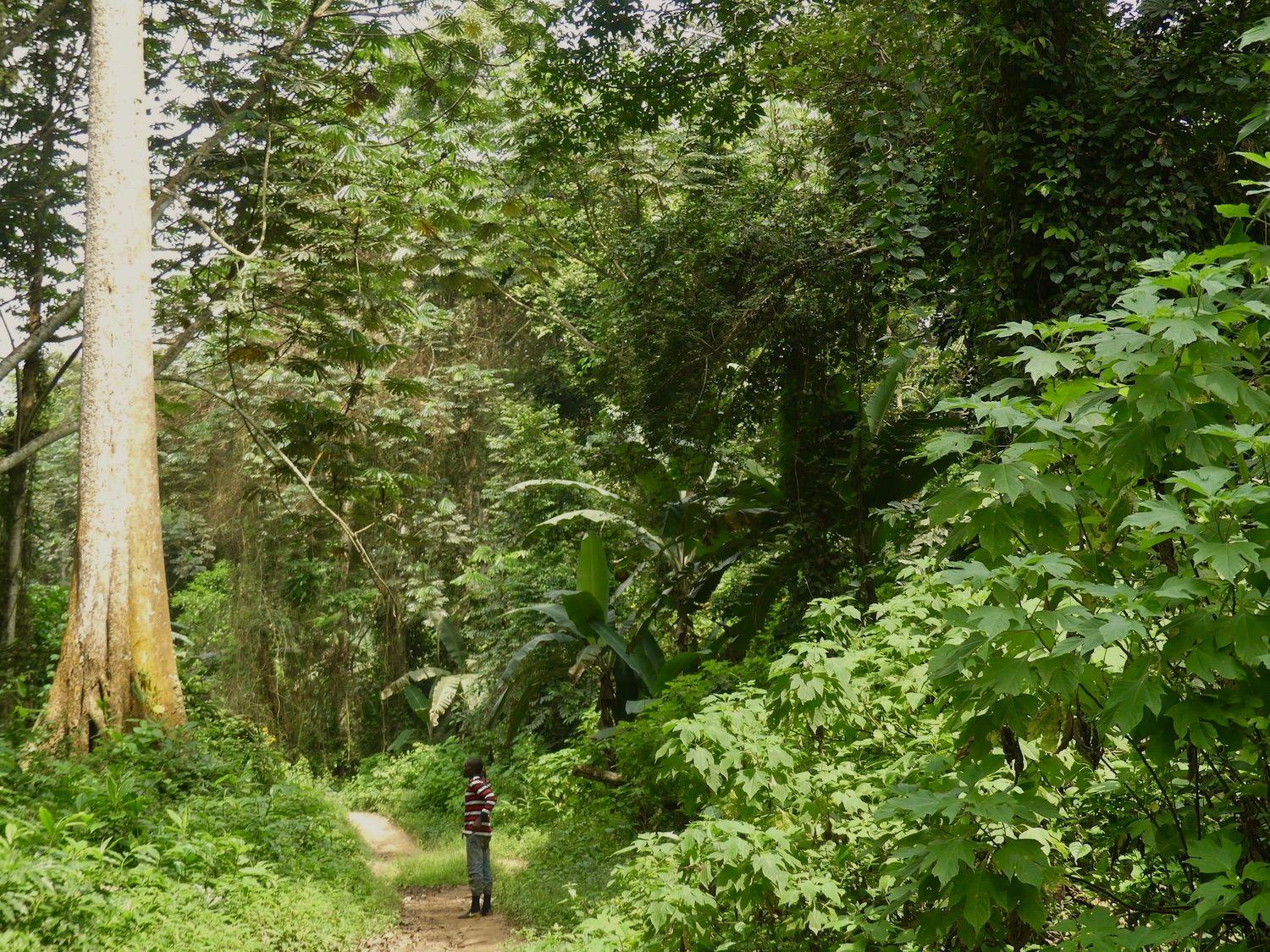
In Cameroon, a farmer contemplates an Ayous tree, the only remaining merchantable hardwood in a forest highly degraded by subsistence agriculture (photo credit: Le Bienfaiteur Sagang, 2018).
Los Angeles, May 5, 2026–A new study published in Nature Communications provides the most detailed picture to date of where carbon is stored and how it is changing across the Congo Basin rainforest, the world’s largest terrestrial carbon sink.
By estimating aboveground carbon (AGC) in every hectare of Congo Basin rainforest from 1990-2020, the researchers find that managed forests, including logging concessions and protected areas, are responsible for nearly all (98.7%) of the region’s net carbon sink. In contrast, unmanaged forests, which store an estimated 54% of the Congo Basin’s AGC, were effectively carbon neutral during the study period—a trend that threatens the region’s long-term ability to absorb global greenhouse gas emissions.
Led by researchers at CTrees, UCLA, and research institutions in Central Africa and Europe, the study warns that without a transition towards more sustainable forest management, the expansive rainforests of the Congo Basin and their capacity to store carbon remain at risk.
“The Congo Basin is often discussed as a vast, monolithic forest, but our results show that carbon sinks and removals vary considerably by ecosystem and land use in the region,” said lead author Le Bienfaiteur Sagang, research scientist at CTrees and a postdoctoral researcher at UCLA Institute of the Environment and Sustainability.
“Currently, nearly half of the Congo Basin’s forest carbon is stored in unmanaged areas, placing it at significant risk of rapid loss from small-scale clearings, mostly associated with smallholder agriculture and urban expansion,” he said.
Spanning six countries and covering approximately 200 million hectares in 2020, the Congo Basin rainforest supports the livelihoods of millions of people. Yet, the region has been chronically under-studied.
"Using advanced technology and rigorous analysis, our study sends a clear message: Sustainable, well‑governed forest use keeps trees standing, protects livelihoods, and locks in carbon," said Sassan Saatchi, CTrees' CEO and chief scientist and senior author of the study. "Investing in governance and responsible management can deliver both local income and tangible global climate benefits."
To map AGC density across the basin, the study combined extensive satellite data with advanced geospatial modeling techniques, calibrating locally trained machine learning models with approximately 825,000 hectares of LiDAR-derived reference data.
The 100-meter resolution map of AGC density for the Congo Basin is a significant improvement on global models and traditional approaches that rely on sparse field plot data. The findings show that the region stored approximately 32.3 billion tonnes of total aboveground and belowground carbon in 2020, representing about 21% of global tropical moist forests’ total carbon stock, and about seven times the annual global emissions from anthropogenic disturbances.
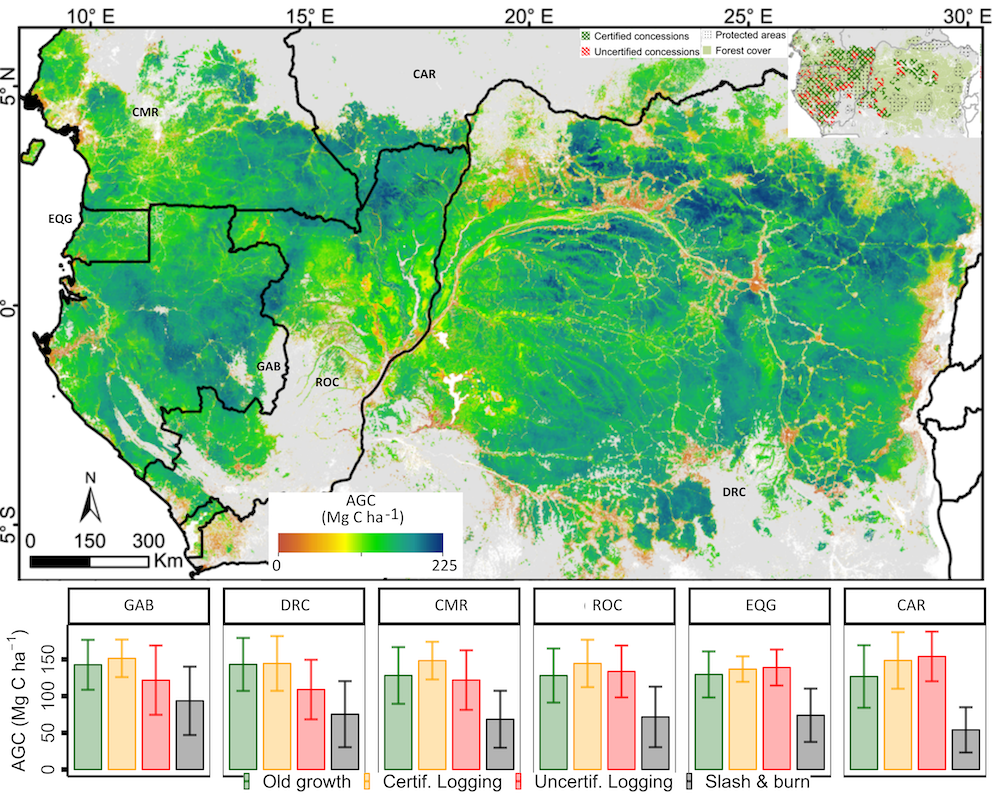
The 100-meter resolution map of AGC density across the Congo Basin (2020) in areas of old growth forest, certified logging, uncertified logging, and slash-and-burn agriculture.
By integrating the AGC density map with 30 years of forest cover change data, the study provides a detailed and policy-relevant view of how carbon stocks, emissions, and removals have changed across the region over time.
An important finding is the role of managed forests, including areas with selective logging, in protecting the region’s carbon sink. Selectively logged forests in the Congo Basin showed, on average, 7.5% less AGC than old growth forests, while areas affected by unmanaged disturbances such as slash-and-burn agriculture showed up to 50% less carbon density. Unprotected forests in the Congo Basin were the source of 79% of emissions, compared to just 21% from managed areas.
“The counter-intuitive lesson is that forests need value, rules and institutions if they are to survive the pressures now building across Central Africa,” said Lee White, an honorary professor at the University of Stirling and co-author of the study. “The choice on the ground is often not between perfect wilderness and managed forest. It is between managed forests that remain standing and unmanaged forests that are vulnerable to piecemeal clearing, illegal roads, fire, mining and slash-and-burn agriculture.”
Cumulatively, small-scale disturbances can outweigh the carbon gains from recovering forests and turn large parts of the rainforest into a net source of emissions. Without active planning, management, and monitoring of the region’s forests, the Congo Basin’s carbon sink remains susceptible to further loss.
Countries like Gabon and the Republic of Congo, which manage more than half of their forests under concessions, offer a promising model for effective forest governance. Investments in timber processing and sustainable logging cycles have supported livelihoods and income for forest communities. By contrast, the Democratic Republic of the Congo manages only 28% of its forests and experienced the greatest loss of old-growth forest during the study period.
“There are often misconceptions around the negative impact of logging in tropical forests,” said Sagang. “Our study shows that selective logging can actually help with carbon sequestration while supporting forests and the livelihoods that depend on them. Recent research has also demonstrated that certified logging can support the basin’s iconic species, like the endangered forest elephant and western lowland gorillas.”
As population growth increases pressures on the Congo Basin rainforest, the study emphasizes the need for countries to improve economic strategies, governance, and monitoring technologies to manage forest resources while protecting their carbon and biodiversity. Sustainable management of unprotected areas is particularly important to safeguarding the Congo Basin’s role as one of the planet’s most critical carbon sinks.
Further resources:
See the study in Nature Communications, Managed rainforests support higher carbon density and sequestration in the Congo Basin, published April 30, 2026.
Read a chapter in the book Resilience and Sustainability in the Congo Basin (2026), How Could Logging Policies and Practices Influence the Future of the Congo Basin Biodiversity and Ecosystems?. The authors include Lee White and Le Bienfaiteur Sagang, and the chapter proposes a model for increasing forest economies and job creation in the Congo Basin by an order of magnitude.


