
Explore the pilot dashboard at forest-intelligence.ctrees.org
North American forests face a host of shifting economic and ecological conditions that range from demands for bio-based products and carbon finance, to risks from disease, drought, and wildfire. In this context, land managers need better data, organized transparently and scaled from individual trees to entire supply sheds.
To develop the future of forest analytics, the Sustainable Forestry Initiative (SFI) and CTrees, a science and technology nonprofit, have partnered to build a pilot data architecture with potential real-time insights to inform forest resilience planning and decision making. SFI and CTrees introduced the pilot at the SFI 2026 Annual Conference in Montreal in May.
Chris Woodall, CTrees’ director of U.S. forest science and policy, said: “We wanted to go beyond building another platform, to really think about the fundamental data needs of forest managers grappling with decisions under rapidly changing climate and economic conditions. The pilot is about identifying the information and analytics forest managers need, and designing a data architecture that can support more resilient forests.”
The pilot platform, now available via CTrees’ website (opens in a new tab), introduces analytics for decision scenarios within supply sheds, the area where a mill sources its wood, often defined by a 60- to 90-minute drive time. By combining ecological and economic data at the supply shed level, the tool is designed to inform local-level management to enhance forest resilience, including through wildfire mitigation planning or carbon reporting.
The pilot is part of SFI’s Climate Smart Forestry (CSF) Initiative, which brings together researchers and practitioners to integrate climate science into practical, forest-focused solutions. Launched in 2024, the initiative is designed to help forestland owners and managers reduce the negative effects of climate change and adapt to changing environmental conditions. To date, the SFI CSF Initiative has produced vulnerability assessments, research collaboration, and on-the-ground action, in partnership with universities, agencies, and forest managers across the U.S. and Canada.
Lauren Cooper, SFI’s Chief Conservation Officer, said: “Improving data and integrating science insights into forest management has been a focus of the Climate Smart Forestry initiative since its inception. With CTrees, we wanted to identify the economic and scientific data needed for resilient forests, and explore how to deliver data to managers in a way that integrates into their existing operations.”
Instead of an isolated platform, the data architecture is designed to integrate with forest managers’ existing dashboards and operational systems. The data stack includes nearly a dozen fundamental metrics including tree species diversity, relative density, aboveground biomass, canopy height, wildfire hazards, and forest productivity at spatial scales ranging from 60 centimeters to 100 meters.
The data in the tool is organized by hypothetical supply sheds, allowing users to explore scenarios in relevant operational boundaries. The tool includes examples of supply shed analytics in California, Oregon, Georgia, and Alabama:
In the Sierra Nevada, accounting for carbon in individual trees and within a delineated supply shed, allowing for aggregated statistics, like the 25-year trend in biomass, maps of variation in tree height across the landscape, and delineation of individual trees’ biomass, volume, height, and diameter.
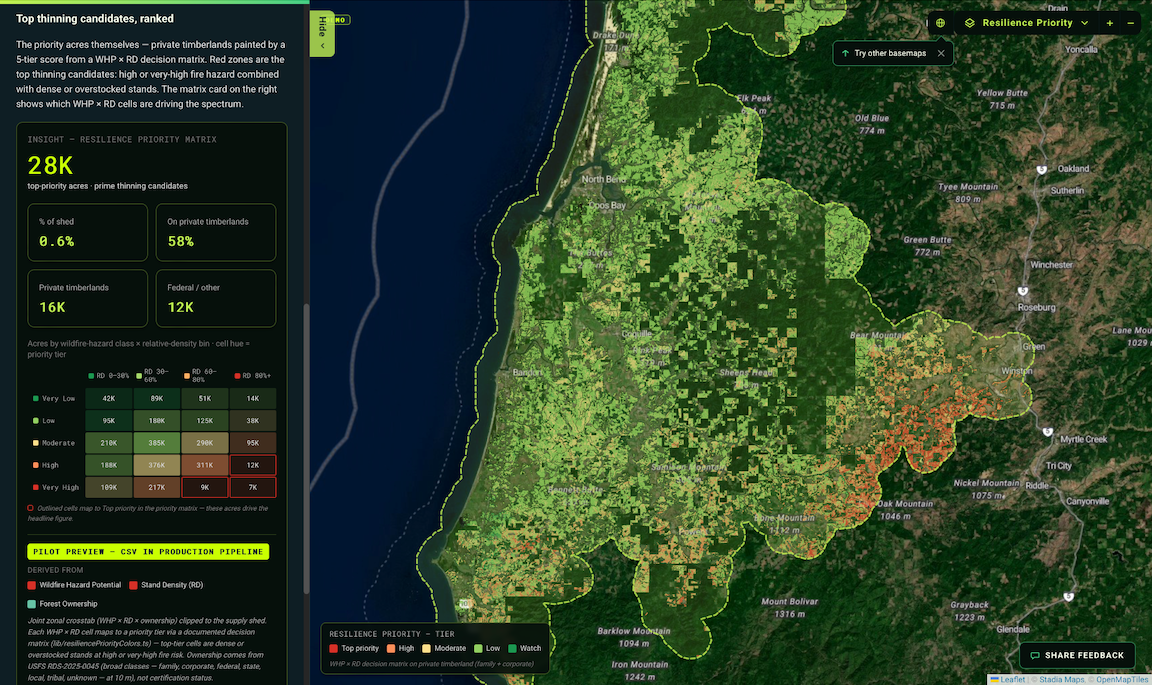
On the Oregon coast, planning for wildfire risk mitigation, by overlapping a wildfire hazard map with stand density and ownership layers to rank priority areas for forest thinning.
In Alabama's Coastal Plain pine belt, simplifying compliance monitoring, by tracking 25 years of carbon change by ownership class, to verify where carbon was maintained, gained, or lost on the private lands that feed mill supply chains.
SFI and CTrees are actively engaging partners to shape the next phase of the pilot, translating the demonstration’s data architecture into operational decision support for forest managers, mill operators, and the certification and investment communities that depend on working forests.
Interested organizations are welcome to share feedback at forest-intelligence.ctrees.org (opens in a new tab) or reach out directly to Chris Woodall.
###
CTrees is a 501(c)3 nonprofit organization dedicated to tracking carbon in every tree on Earth to accelerate nature-based climate solutions. Led by an international team of scientists, CTrees develops technology trusted by leading organizations and agencies to measure and monitor efforts to reduce carbon emissions and restore ecosystems globally. Learn more at ctrees.org.
The Sustainable Forestry Initiative (SFI) is a forest certification program with more than 350 million acres/145 million hectares of forestland in the U.S. and Canada certified to the SFI 2022 Forest Management Standard. Among its requirements are measures to protect water quality, biodiversity, wildlife habitat, species at risk and forests with exceptional conservation value. Objectives on climate smart forestry and fire resilience address critical global sustainability issues and recognize forests as nature-based solutions to the climate crisis. Learn more at forests.org (opens in a new tab).


