Since September, museums across Southern California have mounted more than 50 exhibitions on the "collision of science and art," as part of a major festival called PST ART. From wall-sized projections of agriculture expansion in the Gran Chaco, to an interactive history of remote sensing technology in Los Angeles, and displays of 18th century scientific instruments, the exhibits prompt thinking about how science can help us see the world in a new light.
At CTrees, which was founded as a nonprofit in Los Angeles in 2022, we draw on our home region’s tradition of science and technology innovation, with a mission to help the world "see the forest and the trees," by measuring carbon in every tree on Earth, and making data accessible in open platforms.
CTrees science makes visible the profound changes occurring in forests and other ecosystems on land globally as a result of human activities and climate impacts. In 2024, CTreeslaunched the first map of forest degradation across the tropics, provided the first full year ofbiweekly disturbance alerts in all global forests, and for the third year in a row, released annual data on greenhouse gas emissions from deforestation, fire, and degradation for every country globally.
But CTrees data is designed to do more than visualize change, it also spurs action, allowing measurement of efforts to protect and restore nature, at any scale. This year, our team developed partnerships for monitoring carbon at jurisdiction and project levels, and worked with NGO partners to develop new methodologies to measure improved forest management, agroforestry, and protection of standing forests.
With the holidays around the corner, we want to thank you for your ongoing support. CTrees couldn’t do this work without our partners and supporters. Whether you are spending your time this break visiting with family, seeing your favorite forest (or trees), or getting inspired at your local museum, we hope you have a restful time off, and look forward to reconnecting in the new year.
Following is more detail on our 2024 highlights:
Launching the first global maps of forest degradation in tropical forests
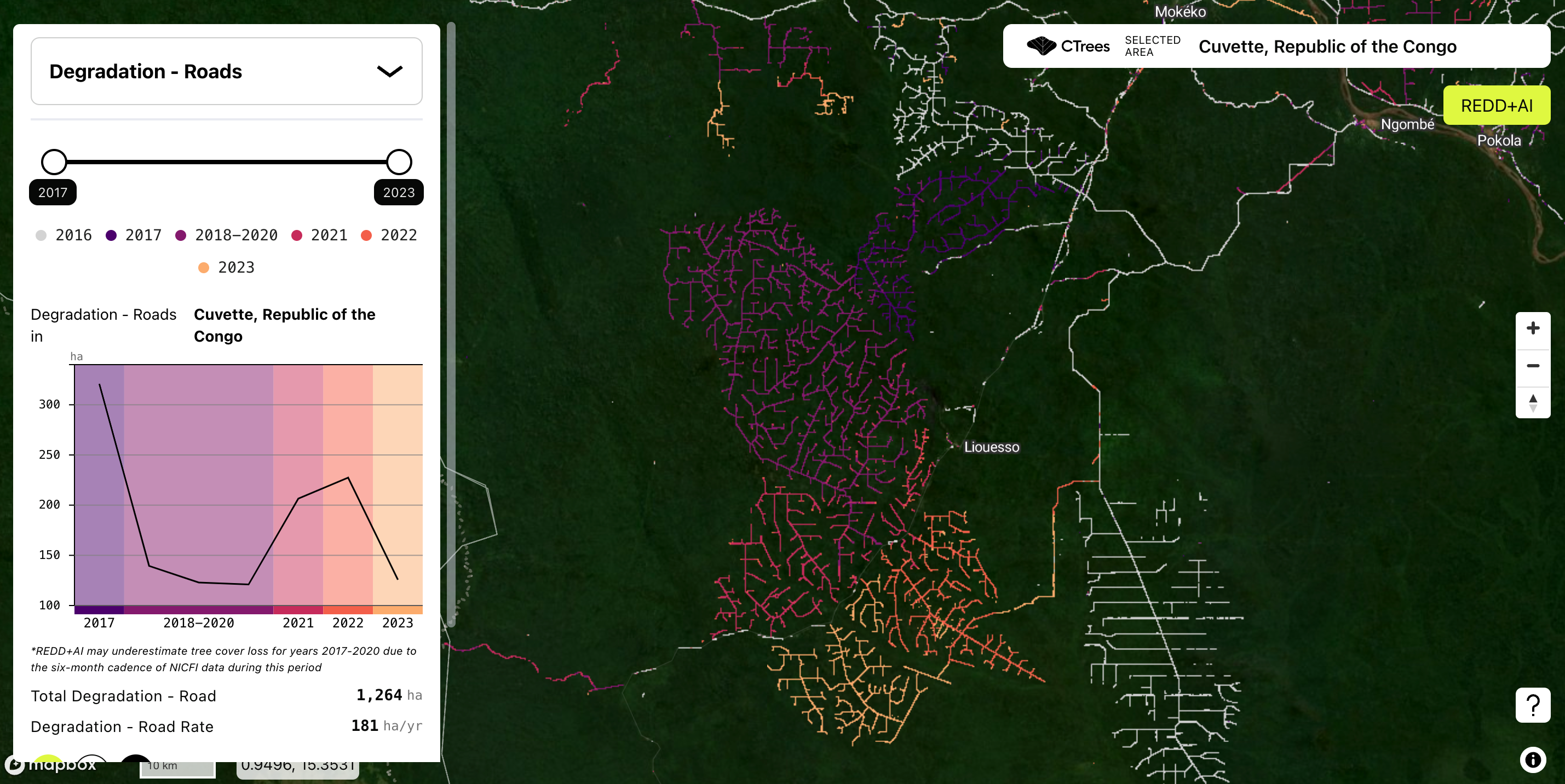
Map of tropical forest degradation from road construction in Republic of Congo, as viewed in CTrees’ open platform, REDD+AI.
In October, CTreeslaunched the first tool to measure forest degradation across all tropical forests worldwide. CalledREDD+AI, the tool includes maps and statistics for every country in the tropics, and is the first pantropic dataset to attribute change to specific drivers including logging, fires, and road construction.
Building partnerships for operational data
CTrees expanded its work on jurisdictional monitoring, reporting, and verification (MRV) this year, building collaboration with government agencies and scientific partners.
In June, CTrees publisheda map of carbon in every hectare of forest in Gabon, the most detailed assessment of the country’s forest carbon to date. The research was funded by the U.S. Forest Service, and involved the collaboration of Gabonese institutions and research partners at UCLA and NASA Jet Propulsion Lab.
CTrees also announced a new partnership with the Lincoln Institute of Land Policy to deliver MRV data for a federally funded$25M restoration initiative in the Connecticut River Watershed.
Providing the first year of radar alerts for all forests globally
In 2024, CTrees provided the first full year of reliable, radar-based alerts for all global forests via its openLand Use Change Alerts (LUCA) tool. Covering temperate, boreal, and tropical forests, the data allow for continuous monitoring of deforestation and degradation activity at any scale, from projects to jurisdictions, and with historical perspective from 2018 to present.
Bringing together leaders in jurisdictional finance at Climate Week NYC
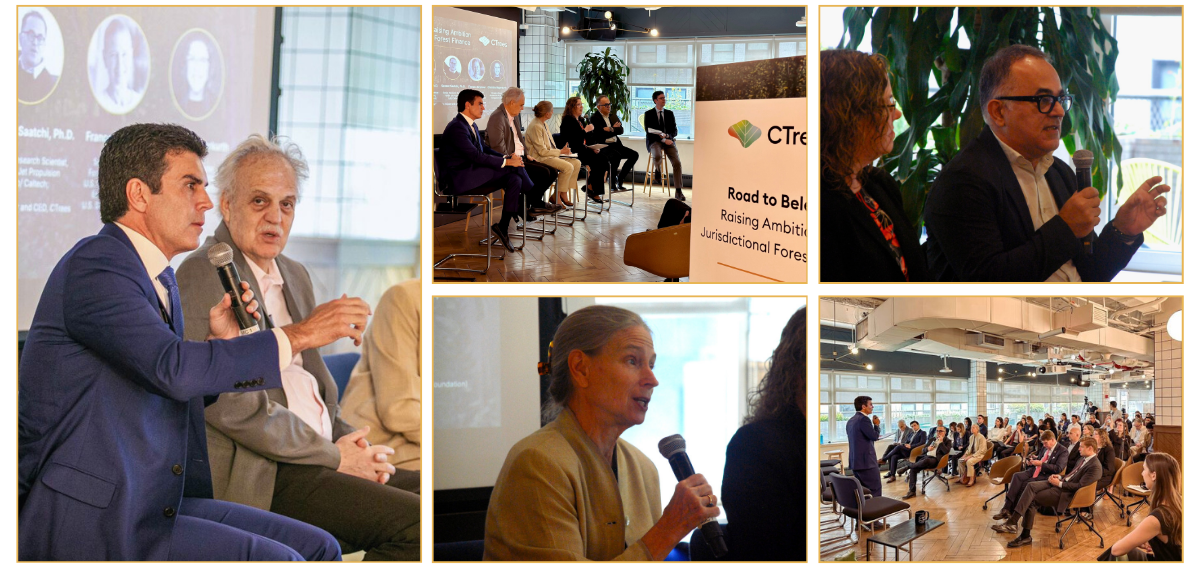
Photo credits (clockwise L to R): Thalmus Gama Ag. Pará, Raymond Song, Aijing Li, Thalmus Gama Ag. Pará, Aijing Li
In September, CTrees hosted a Climate Week NYCpanel on jurisdictional REDD featuring a keynote from Governor Helder Barbalho of Pará, Brazil, who shared details on a$180 million deal for jurisdictional carbon credits announced the morning of the event.
The expert panel spoke to over 125 attendees and included Brazilian scientist Carlos Nobre, U.S. State Department senior advisor for forests Frances Seymour, Architecture for REDD+ Transactions managing director Christina Magerkurth, and our CEO Sassan Saatchi.
Climate Week NYC was one of 10 policy conferences and events that CTrees participated in throughout 2024, including speaking engagements at North American Carbon World, IETA Latin America Climate Summit, and VERGE24.
Updating the only global land carbon map
At COP29, CTrees released 2023 data on land carbon for all countries globally in itsJurisdictional MRV tool. The updated data includes annual statistics on carbon stocks, emissions, and removals in forest and non-forest ecosystems from 2000-2023.
CTrees also contributed to the Climate TRACE coalition’s open emissions inventory, providing estimates of global emissions and removals from the land sector including carbon fluxes from land use activities , providing annual GHG inventory across global forests, grass and shrublands, and wetlands.
Highlighting our science innovation at AGU24
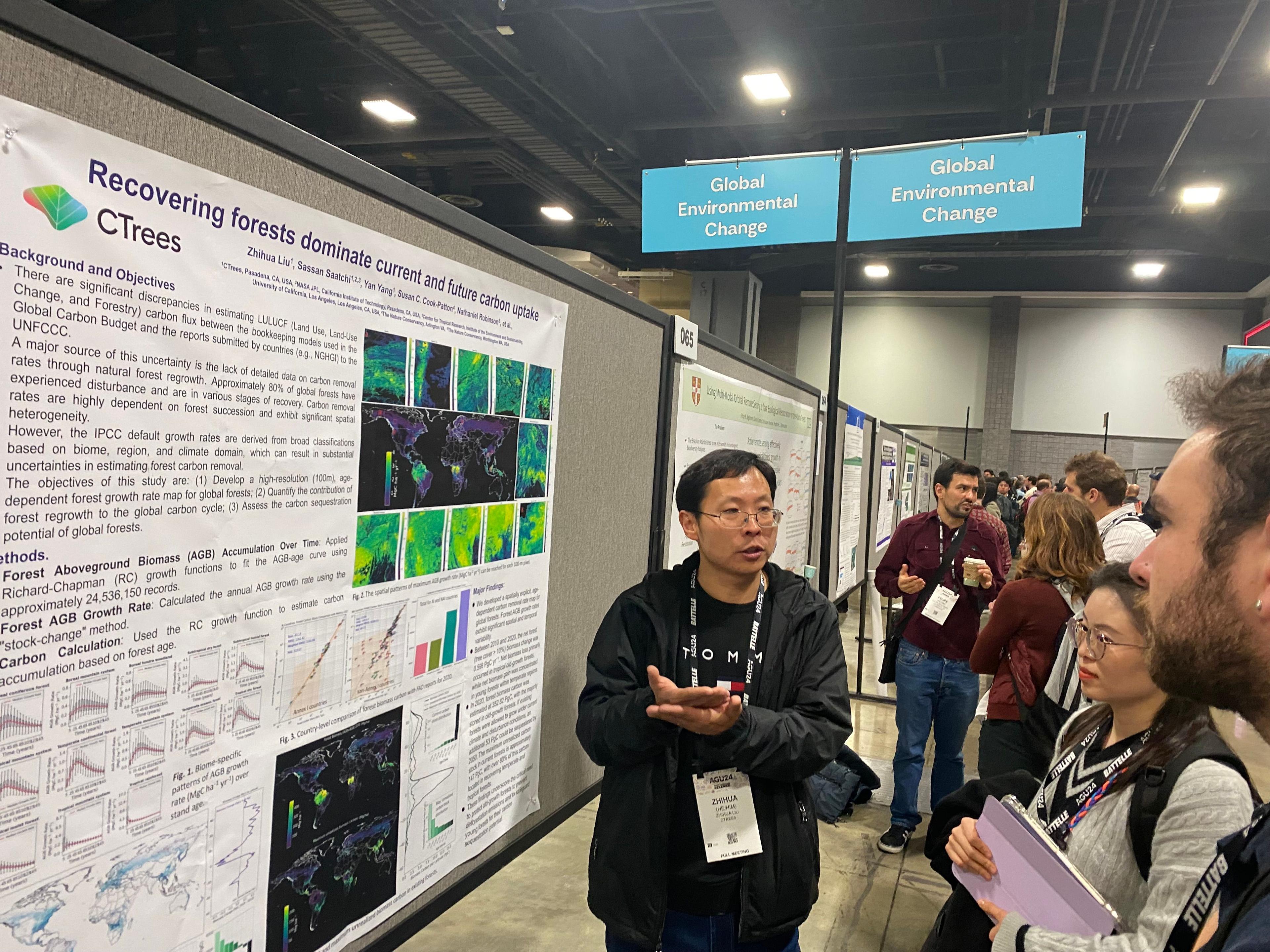
CTrees scientist Zhihua Liu presents findings at a poster session at AGU24; photo credit: Cynthia Creze
In December,nine CTrees scientists presented at AGU24, the largest annual gathering of Earth and space scientists in the world.
Our scientists shared innovative research on topics such as modernizing the global stocktake, improving soil carbon mapping, assessing urban canopies across the U.S., and exploring fine-scale structure and carbon stock variations of tropical forests across the Amazon and the Congo Basins.
Delivering data and insights to carbon markets
In 2024, CTrees expanded itswork with Verra to provide jurisdictional data for the nonprofit’s consolidated REDD+ methodology. CTrees provided forest activity and risk benchmarking data in jurisdictions across Latin America, Africa, and Asia.
CTrees also established partnerships with nonprofits to develop new methodologies on improved forest management, agroforestry, and high-integrity forests, with more details to be announced in 2025.
Gathering for our annual staff retreat
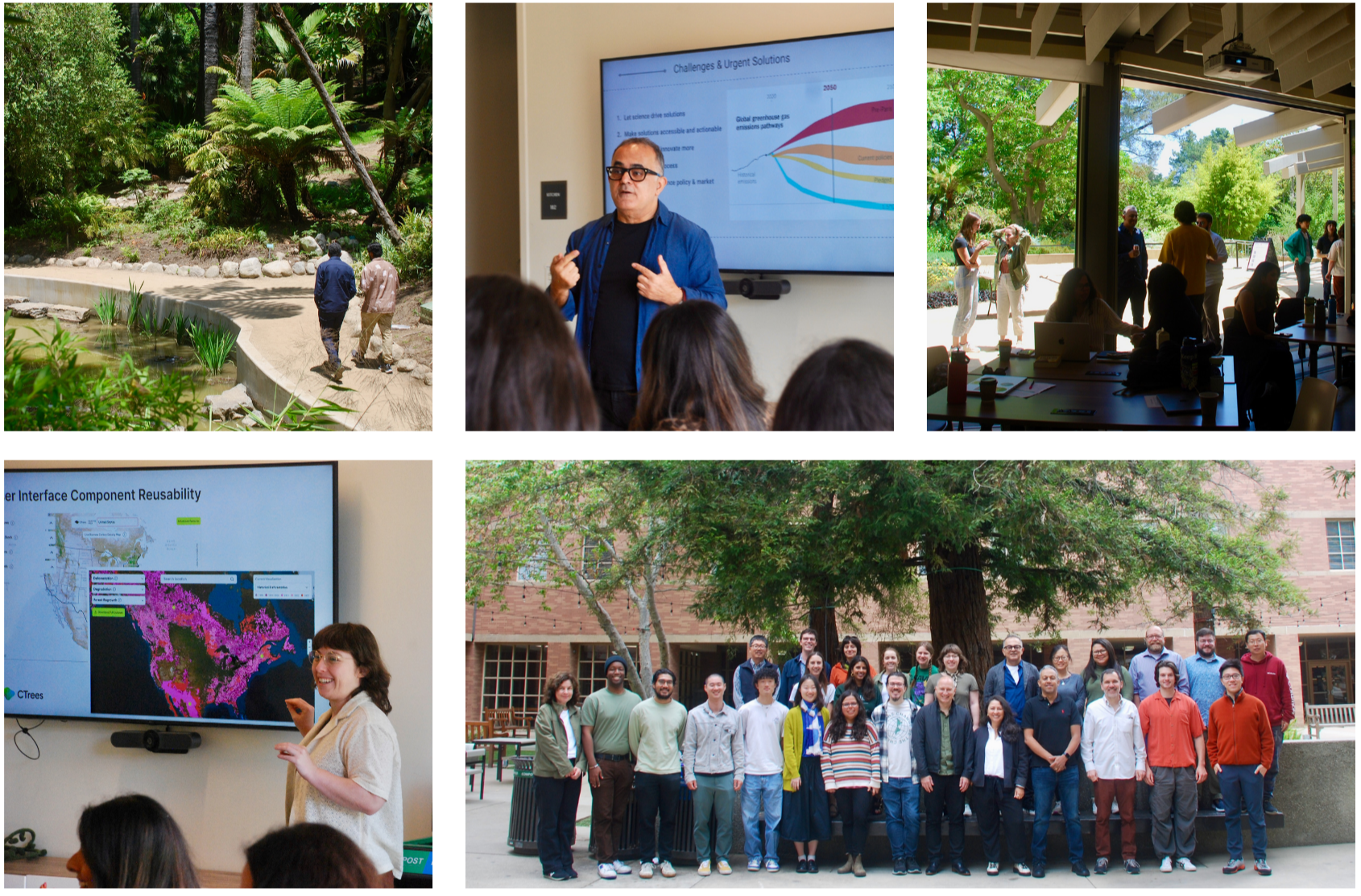
Our staff convened for an annual retreat held on UCLA’s campus; photo credits: Daniel Melling
In June, CTrees’ team of more than 30 scientists and staff came together for an annual retreat at UCLA. Team members spent time reflecting on past progress and strategizing for how to advance our work measuring carbon in the world’s forests and trees.
Measuring trees across the Amazon
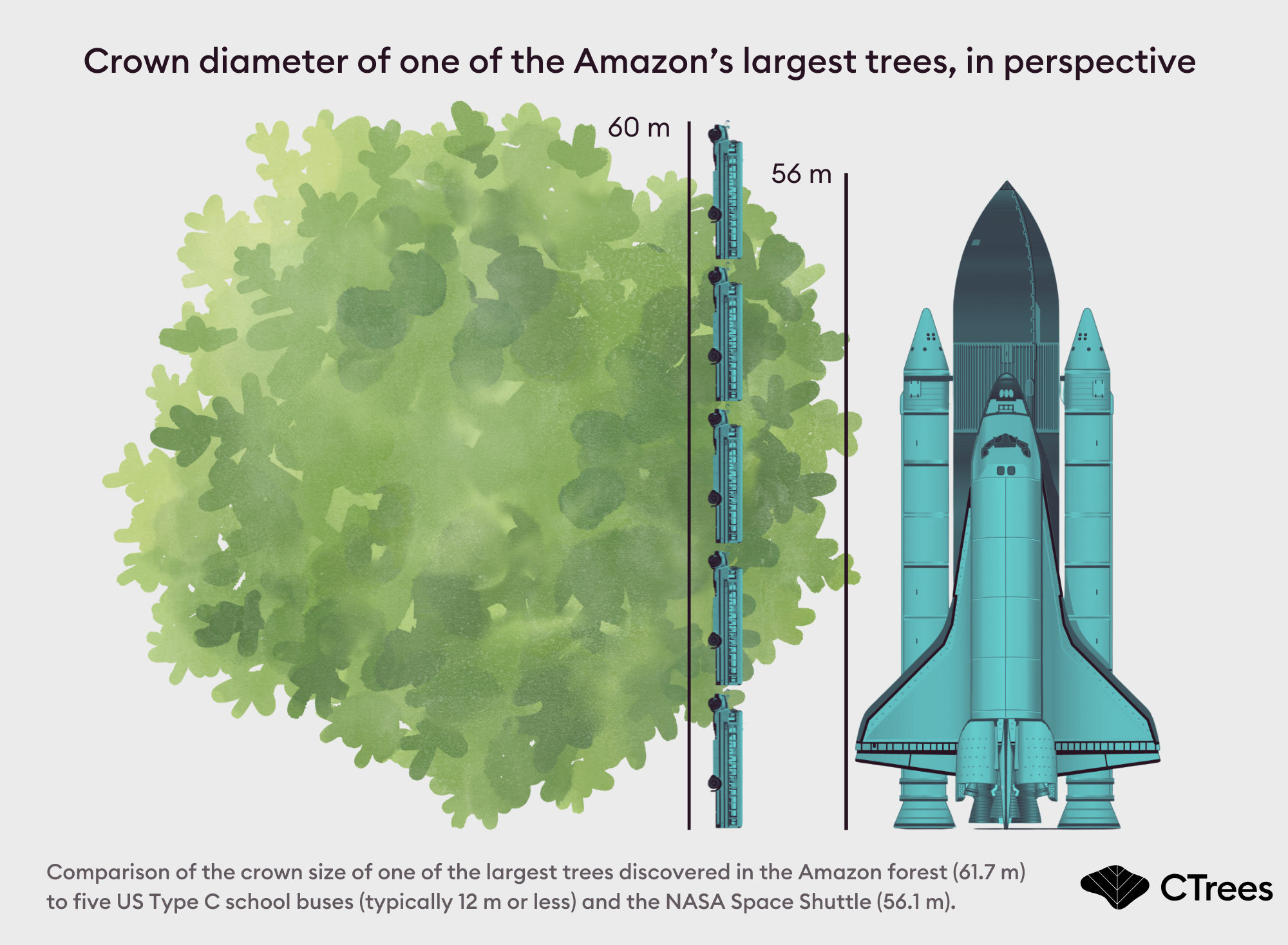
This year, CTrees scientist Fabien Wagner found what is likelyone of the largest trees in the Amazon forest, as part of his larger research to map canopy height across the region. In a Q&A, Wagner emphasized the significance of this discovery and the importance of individual trees to overall forest ecosystems and conservation efforts.
At CTrees, we recognize the importance of all trees globally — whether inside or outside forests. We look forward to continuing our work with you in the new year to protect trees and restore ecosystems worldwide.


