
With an estimated 400 billion trees in the Amazon, tracking any individual tree may seem like an impossible task. But CTrees scientist Fabien Wagner challenges us to see the importance of each tree in the world’s largest rainforest – particularly the biggest ones.
An expert in tropical forests and a former researcher at NASA Jet Propulsion Lab and Brazil’s space agency, INPE, Wagner is currently working to map tree canopy heights across the Amazon forest, and will present his research next week at AGU24 [1]. Preparing for the presentation, Wagner came across an exceptionally large tree.
The largest tree in the Amazon, perhaps?
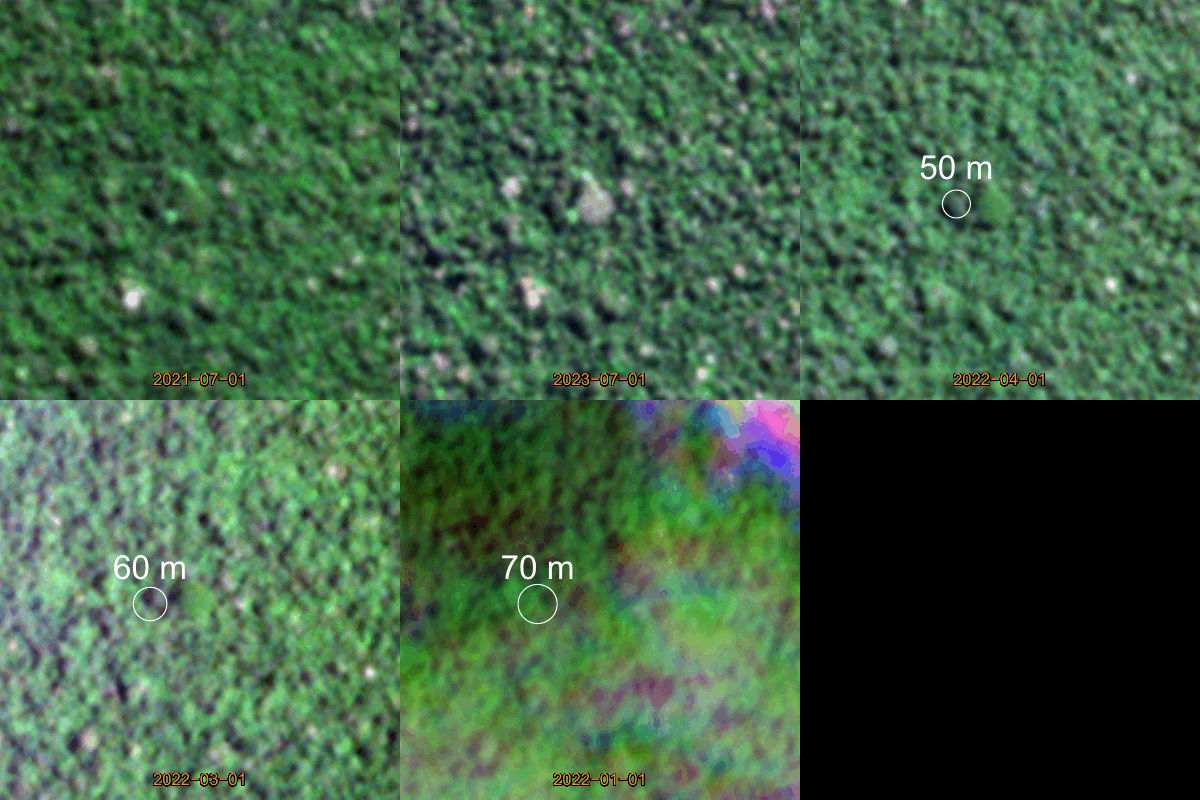
Time lapse of the Amazon forest, Jan. 2021 - Jun 2024, reveals a tree with a crown diameter of more than 60 meters. Images obtained via Planet NICFI program.
Our communications manager Rachel Kovinsky recently sat down with Wagner to learn more about this finding, his research, and the importance of individual trees to larger forest ecosystems and conservation efforts. Read our conversation below:
1. Can you tell us a bit about what exactly we’re seeing in this time lapse and why it’s significant?
The three-year time lapse shows an area of the Amazon forest, as seen via satellite imagery from the Planet NICFI program. Each consecutive image represents one month, from January 2021 through June 2024. The image contains about 400 x 400 pixels, with each pixel corresponding to approximately 5 x 5 meters on the ground. Mostly, we see what you would expect for the Amazon: large crowns that dominate the canopy and the changing of leaves.
But right in the middle, there is an exceptional individual tree with a crown diameter of more than 60 meters. The crown is about 10 to 20% wider than all other large trees I found in the Amazon. It’s slightly more than the length of five US school buses back to back [standard Type C school buses are typically 12 meters or less in length].
Later, I found an image with a better resolution on Google Earth Pro where we can see more details of the crown and its exceptional size.
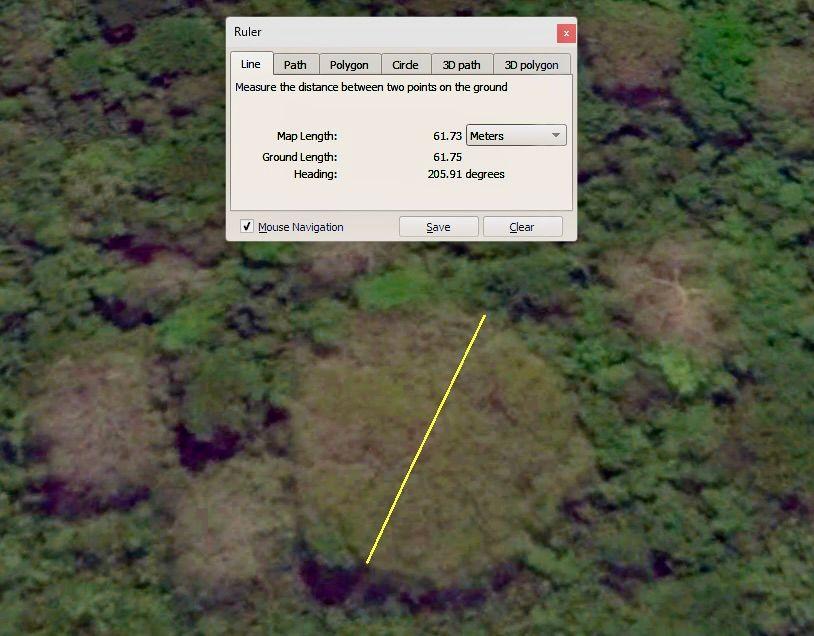
Image obtained via Google Earth Pro
This particular tree is likely one of the largest in the Amazon. I estimate that it is over 50 meters tall. It may represent the upper limit of carbon sequestration and productivity (i.e., making wood, leaves, roots, and fruits) for any tree in the Amazon.
Some trees in the Amazon are taller – a recent study found trees greater than 80 meters in height. But these trees typically have smaller crown sizes. More research is needed to understand whether trees with the tallest height or those with the largest crowns have the most biomass, but both the tall trees and the large crown size trees are at the limit of what can be observed, in terms of biomass.
With help from Robson Borges de Lima, who works on giant Amazon trees at the State University of Amapá - Brazil, (@Robson_Forest), we believe that this tree could be of the species Bertholletia excelsa, the tree species that produces Brazil nuts, an edible seed commercially distributed around the world. Another candidate species for such a giant crown could be Parkia pendula.
2. How did you come across this tree? What research were you working on?
I am currently working on a model to map the tree canopy height of the entire Amazon forest using Planet NICFI images. The model can detect canopy height up to 45-50 meters. By inspecting the results, we can discover the tallest and largest trees in the entire Amazon.
For this tree, specifically: I had previously searched the data for individual trees with a crown diameter of 50-55 meters, which to my knowledge, is the largest possible crown size observed in the Amazon. After finding a few trees in this range, I realized that, statistically, an even larger tree could exist. That’s when I expanded my search, bringing me to this exceptional specimen.
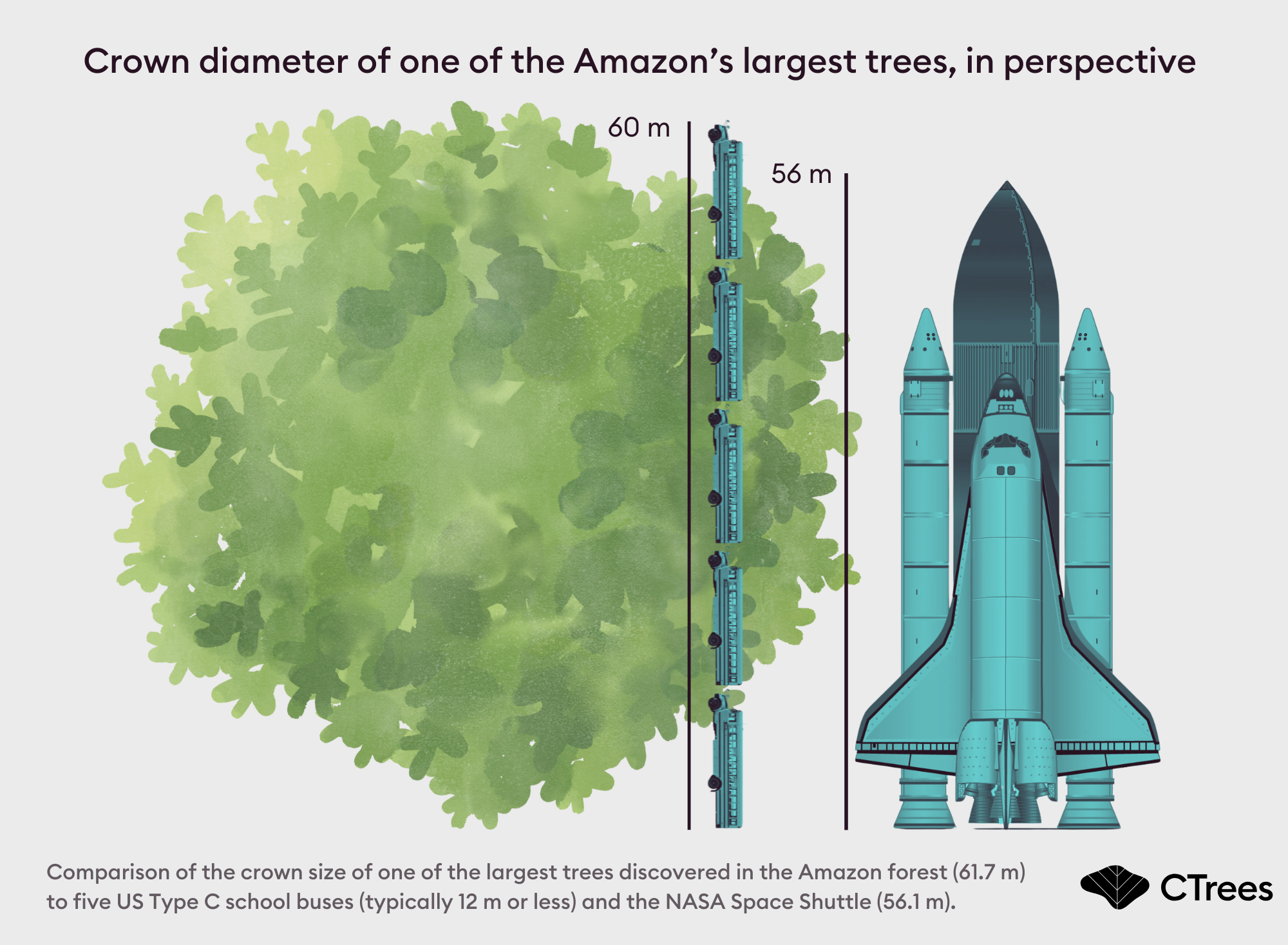
Crown diameter of the Amazon specimen compared to five standard Type C school buses and a space shuttle.
3. What was your reaction when you came across this tree and what surprised you, if anything, about this finding?
I was very surprised and shocked to see such a tree. It is enormous relative to the surrounding landscape. All the other nearby trees, even the largest ones, look pretty small in comparison.
I was also very happy that this tree seems to be healthy – changing all of its leaves regularly each year. The tree does not seem to have many vines [that can damage the crowns of old trees]. From the satellite images alone, it does not seem that the tree is directly threatened by deforestation, but we have some new information that legal extraction is planned nearby.
4. Can you explain a bit more about the process behind measuring tree cover?
We start with open source data on canopy height measurements collected from airplanes using a laser technique called LiDAR [light detecting and ranging]. Scientists have run several LiDAR collections across the Amazon, but it only covers a fraction of the forest.
Our approach is to match the LiDAR data with cloudless satellite imagery taken on the same date. We train a deep learning model to reproduce the true canopy height obtained by LiDAR from the satellite image. When the model is well trained, we can feed it a satellite image and it returns the canopy height for the entire image.
The model’s main advantage is that it can calculate the canopy height wherever we have NICFI satellite imagery. The NICFI images are produced every month across the Amazon, a frequency that no other remote sensing source (airplane, drone, or other open data satellites) can achieve.
5. Your research uses a combination of satellite imagery and deep learning models to map forest ecosystems — why are these innovative forest monitoring techniques important? How can this type of research help address larger issues like deforestation and advance better climate mitigation policies on a global scale?
Deep learning techniques are extremely fast and accurate, and can be scaled across large areas and many years, or months, of data.
Existing datasets are limited – the open source LiDAR data we use for training only covers around 0.15% of the Amazon. But with a deep learning model, we can predict the canopy height of the entire Amazon forest, and we can repeat the analysis for every month that cloudless images are available. That is a huge step forward.
Some deep learning techniques can copy human tasks, like delineating objects in images, but faster, and other techniques, like the one employed here, do a task that can only be achieved by machines, and they can do it extremely fast. Deep learning helps to bring new information about the forest, forest cover, forest structure, and forest changes with high accuracy and at large scale.
This data can be used to monitor forest cover changes, like deforestation. Canopy height data can also be used to measure regeneration, estimate carbon stock, and observe the natural characteristics of the remaining Amazon forests.
6. Why are large trees like this one important to our carbon sink and forest ecosystems?
Studies show that the biomass of a forest is directly related to – and can be estimated by – the size of its largest individual trees. Forests with higher biomass have higher overall productivity [2].
Losing forests like the Amazon with large individual trees disproportionately impacts the global carbon cycle, and leads to an overall decrease in biosphere functioning. There’s also an associated biodiversity loss, as some species depend on large trees for their habitat.
7. How do findings like this contribute to our broader understanding of the Amazon?
The Amazon forest is critically endangered, reduced each day due to deforestation and degradation. We urgently need to document the forest by all means possible in order to ensure its long-term protection.
I feel that we have a false impression that the Amazon forest is scientifically well known and mapped, but this is far from the reality. Every new data counts.
Our data can help to better characterise ecosystems and individual trees inside of the Amazon, highlighting their uniqueness. Our height maps can also shed light on forest dynamics that are difficult to measure from the ground, such as tree mortality, to improve understanding of the carbon cycle in tropical forests. And, of course, this data complements existing tree cover data in monitoring the extent of deforestation and degradation.
8. Is there anything else that you’d like to share about your research?
I hope that this discovery makes the beauty of the Amazon forest more visible.
Large trees are iconic and charismatic. They are natural wonders. Such trees can help promote conservation efforts, like Sequoia National Park in California.
Trees can also be an important starting point for ecotourism and the development of a more sustainable economy in regions that are currently on the path of deforestation.
References
[1] Wagner, F.H., “High Resolution Tree Height Mapping of the Amazon Forest,” poster presented at AGU24, Washington, D.C., December 11, 2024.
[2] Enquist, B.J., Abraham, A.J., Harfoot, M.B.J. et al. The megabiota are disproportionately important for biosphere functioning. Nat Commun 11, 699 (2020). https://doi.org/10.1038/s41467-020-14369-y


