
It was late afternoon by the time our group reached the edge of one of Arizona’s most expansive national forests.
From a lookout point along the Mogollon Rim, a dramatic escarpment that forms the southern edge of the Colorado Plateau, three different realities for Arizona’s forests were on display.
Directly around us, trees and shrubs still bore the blackened scars of a lightning-sparked wildfire that tore through the area just a few months earlier. Nearby, an area of forest appeared dense and overgrown with vegetation, while an adjacent patch had only a scattering of sparse trees.
The three distinct landscapes told a deeper story about the relationship between Arizona’s forests and fires, and the cross-sector forces shaping their future.
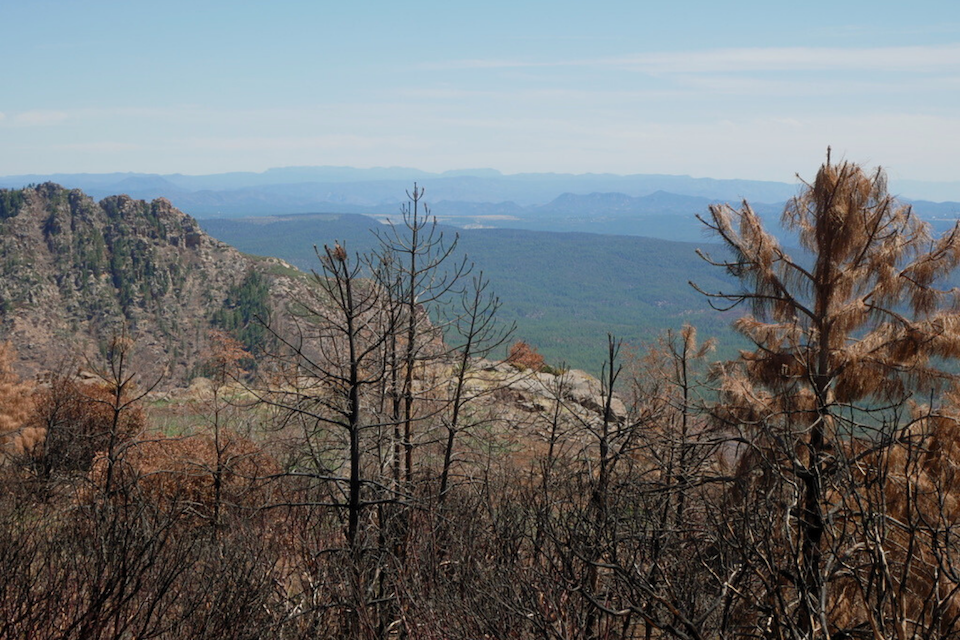
An overlook at the edge of the Mogollon Rim, where lightning sparked a wildfire in September 2024 (photo by Rachel Kovinsky).
Towards more collaborative forest management
I was in Arizona’s national forests that day with a group of environmental reporters, scientists, and communicators as part of this year's Society of Environmental Journalists (SEJ) conference, held at Arizona State University (ASU) in Tempe. The field trip was an opportunity to learn about the interagency initiatives working to restore the state's forest landscapes.
Discussions about Arizona’s environment and climate typically fixate on the state’s deserts and scorching temperatures, leaving its six national forests–situated far from densely populated urban areas–easy to overlook.
But Arizona’s forests have a significant impact on the local economy and ability to sustain modern life.
Although the local lumber industry has been through a period of decline in recent decades, forest restoration initiatives are bringing new economic activity to the region, alongside the widespread realization that the health of the state’s forests has far-reaching implications for electricity generation, water quality, and other essential services.
Arizona residents, whether they know it or not, depend on the state’s forests.
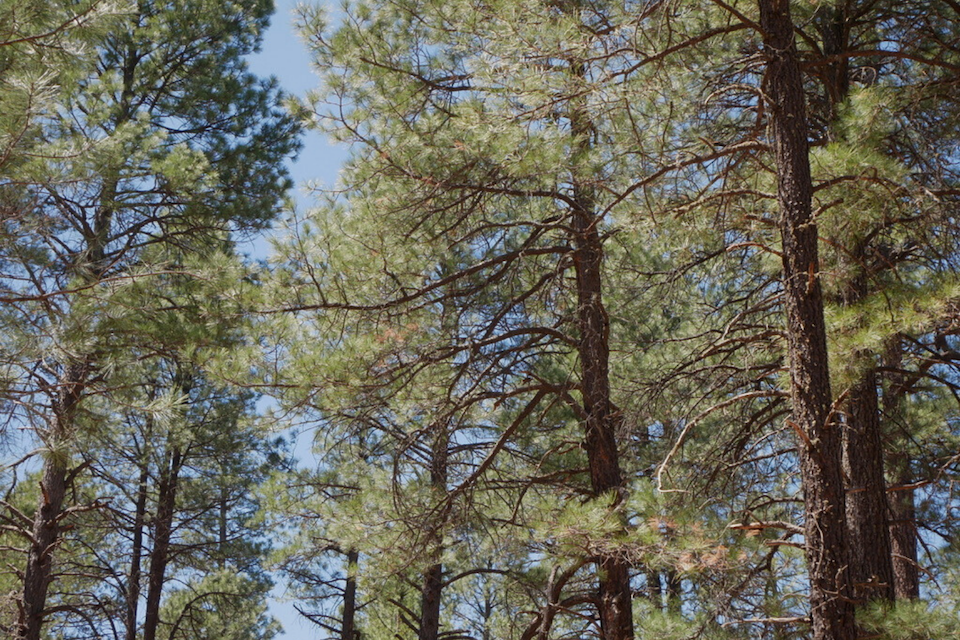
Trees at an active restoration project area in a national forest located north of Payson, Arizona (photo by Rachel Kovinsky).
As we entered Coconino National Forest, I noticed the crisp morning air. The temperature had dropped significantly from our starting point nearly 100 miles away in downtown Tempe.
Donning hard hats and hi-vis vests, we gathered to hear from experts leading the ambitious restoration initiatives reshaping Arizona’s forests.
The Salt River Project (SRP), a non-profit provider of water and energy for more than 2 million Arizona residents, is one of the leading partners on this work. The utility’s involvement may seem surprising, but stems from a growing recognition of the interdependence between the health of the state’s forests and watersheds.
Much of Arizona’s water supply originates as rainfall and snowmelt in forests, so escalating threats from forest fires have direct implications on local water quality.
To ensure a more resilient water supply, SRP realized that its work needed to transcend the traditional silos of water, forest, and fire management. In other words: to protect the state’s water supply, the utility needed to protect the state’s forests.
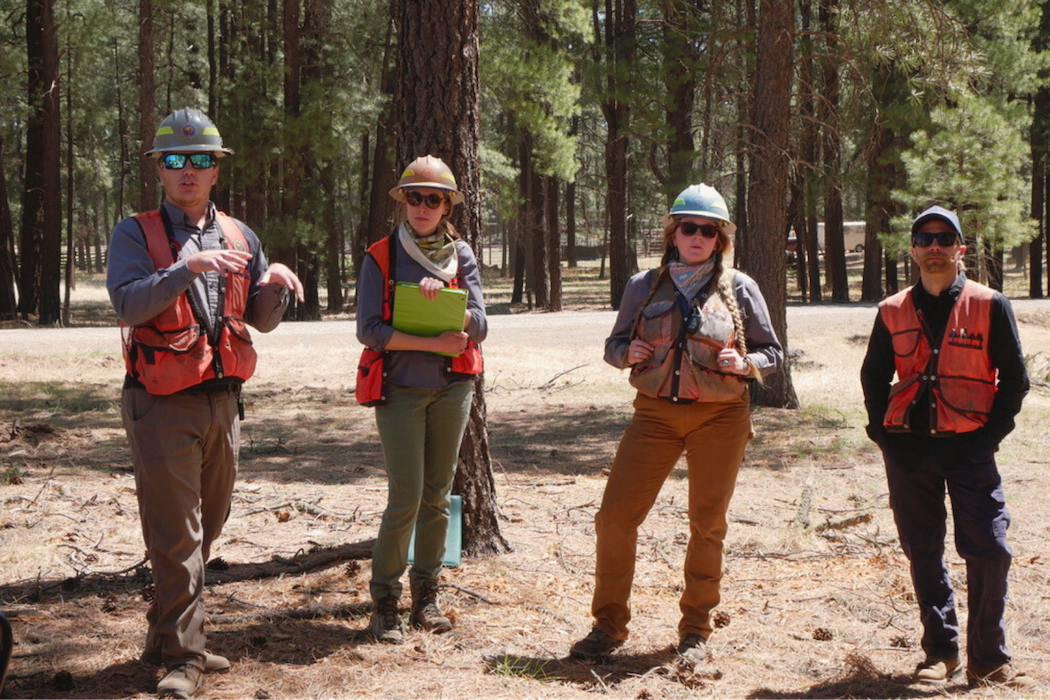
Local organizations and agencies discuss the collaborative efforts restoring forests across Arizona (photo by Rachel Kovinsky).
SRP has since partnered with the Arizona Department of Forestry and Fire Management, Arizona Game and Fish Department, National Forest Foundation, and Suarez Foresty (a local family-run timber company), on targeted restoration projects to improve local forest health and reduce wildfire risk.
“Relationships (are) what gets the stuff done,” said Elvy Barton, senior manager for water and forest sustainability at SRP. By 2035, SRP aims to thin 800,000 acres of overgrown forests in Arizona, a process that involves the targeted removal of small trees to reduce forest density and mitigate damage from future wildfires.
Forest restoration and fire mitigation in action
Standing at a safe distance, our group watched as a feller-buncher (specialized logging equipment that cuts down and stacks trees) removed towering trees in a matter of seconds, before placing them neatly into piles on the forest floor.
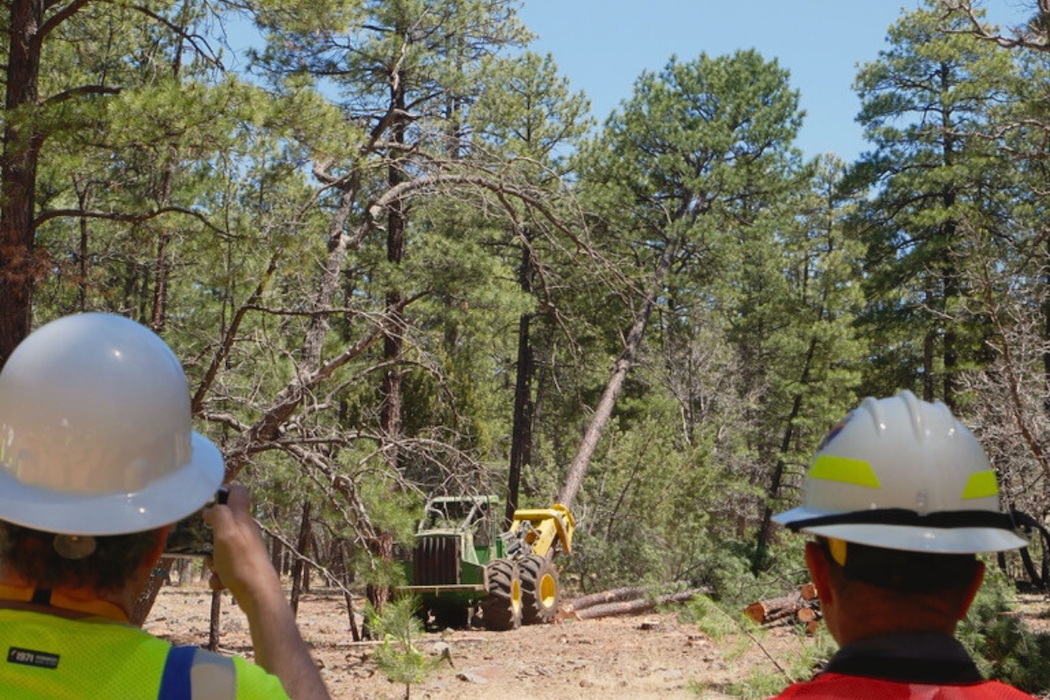
A feller-buncher chops down trees to reduce forest density and promote forest health (photo by Rachel Kovinsky).
Admittedly, it may seem contradictory to help a forest prepare for an uncertain future by cutting down trees. But when a forest has too many trees growing too closely together, the trees must compete for vital resources. This dynamic harms tree health and creates the ideal conditions for wildfires that are beyond anything seen in recent history.
In other words, overgrown forests exacerbate the risk of catastrophic wildfires—but reducing the density of vegetation can help.
By removing trees that fuel potential fires, forest thinning helps lessen the intensity of wildfires to come. The practice has also been shown to improve drought resiliency and increase biodiversity in treated areas.
Forest thinning also explains the sparse forest landscape visible from the lookout point along the Mogollon Rim. According to Barton, targeted efforts to thin the area prevented further damage during the recent lighting-sparked fire.
Fighting fire with…fire?
Stephen Pyne, emeritus professor at ASU and an expert in the area’s fire regime, provided a more long-term perspective on the relationship between Arizona’s forests and fire.
Pyne spent 15 years at the start of his career as a firefighter in Arizona’s Grand Canyon. These early and formative experiences fighting fires in the field, followed by decades of research as an academic, shaped his understanding of the disconnect between modern forest and fire management practices.
Economic forces dating back to the 1870s disrupted the centuries-long rhythm and cadence of fire, Pyne noted. When twentieth century federal policies (like the 10 a.m. policy) took effect, they prioritized total fire suppression and further disrupted traditional fire regimes. In doing so, they created the prime conditions for the devastating wildfires that we’re experiencing today.
“We’ve wiped out the middle class of fires,” said Pyne. “And now, all that’s left is the top one percent.”
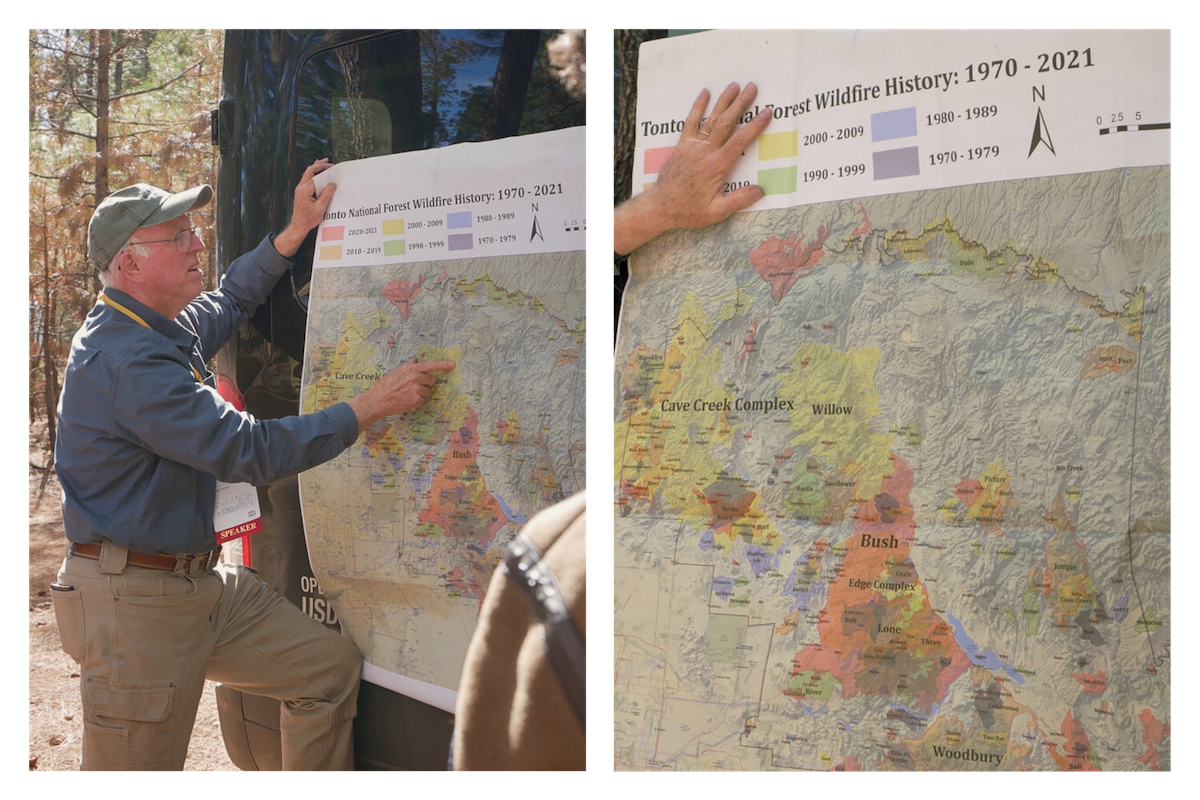
Stephen Pyne points to a map highlighting the increasing size and severity of recent wildfires in Arizona (photos by Rachel Kovinsky).
Discussing the future of fire mitigation and forest management in Arizona, Pyne argued that forest thinning alone is insufficient. Instead, he argued that we need a combination of consistent maintenance burning and thinning.
According to Pyne, fire is just as much a part of the solution as it is a part of the problem.
“We really do have [the] capacity to manage things if we do it in a patient way,” he said.
The patient way, from Pyne's point of view, will involve recognizing the unique needs of Arizona's distinct geographies and ecosystems, and tailoring fire and forest management strategies accordingly.
The role of data and journalism in building a more resilient forest future
As we boarded the bus back to Tempe, I found myself reflecting on the difficulty of addressing the threats that our forests are facing.
Intrinsically, bringing greater visibility to our forests is difficult.
One of the only times that urban residents are directly faced with forest issues is when the effects of massive wildfires reach major cities—like the smoke that enveloped São Paulo during last year’s historic fires in the Amazon, or the orange haze that swept across New York City from Canadian wildfires in 2023.
These events may galvanize political change, but we need journalism and data to bring greater accountability and awareness to sustained threats to global forests.
In the days following our field trip, several sessions at SEJ emphasized the important role of media in bringing attention to forests, including a panel discussion moderated by my colleague Daniel Melling.
Panelist Caleigh Wells shared insights from her reporting for The California Newsroom on prescribed burns in California’s Big Bear Valley, while Mongabay reporter Karla Mendes described her investigations into illegal cattle ranching in indigenous territories of the Brazilian Amazon. Both Wells and Mendes demonstrated how reporting can shine a spotlight on threats to forests that may otherwise feel distant, abstract, or simply out of sight.

(Left to right) Caleigh Wells, Karla Mendes, Michael Dorsey, and Daniel Melling speak on a panel about global forests and the road to COP30 at the 2025 SEJ conference.
Open data tools can also bring greater transparency to the changes happening in our forests.
Policymakers today face difficult decisions about how to best manage forests facing drought, extreme heat, and other climate impacts across the West. And at an operational level, forest managers must make decisions about how and where to intervene with limited resources.
Scientific data and advancing mapping products, including those produced by CTrees, can guide both policymakers and forest managers, providing important information on historical trends and informing future restoration efforts, like the initiatives we saw unfolding across Arizona's forests.
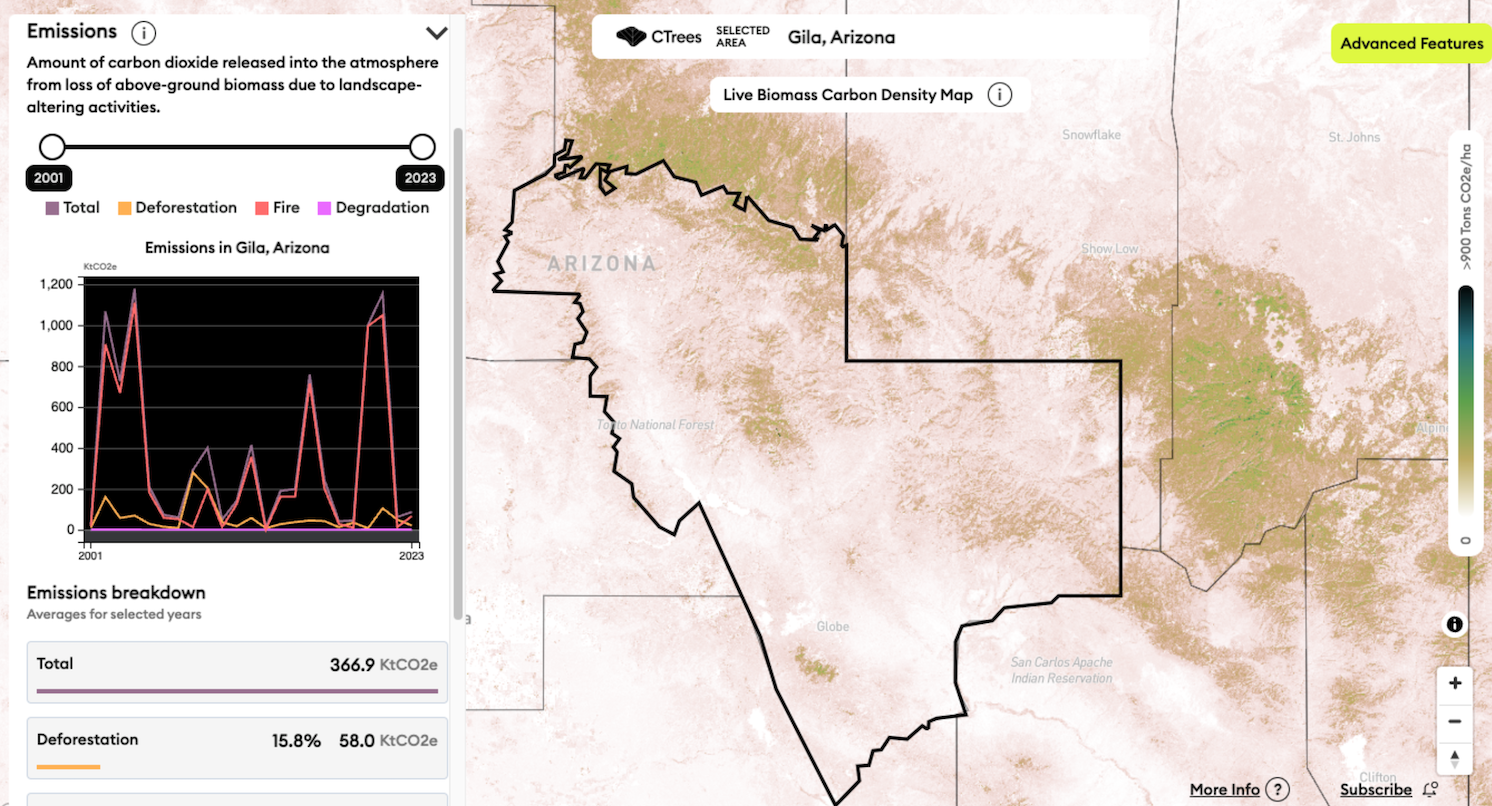
CTrees’ JMRV platform calculates emissions from deforestation, fire, and degradation in Gila County, AZ, which includes portions of Tonto National Forest.
In retrospect, if I learned one thing during my time in Arizona, it’s that the health of forests has widespread implications for us all.
These ecosystems do not exist in silos—and neither can our efforts to protect them. Forests are an important part of the equation to solving the climate crisis, and we must prioritize them accordingly.


