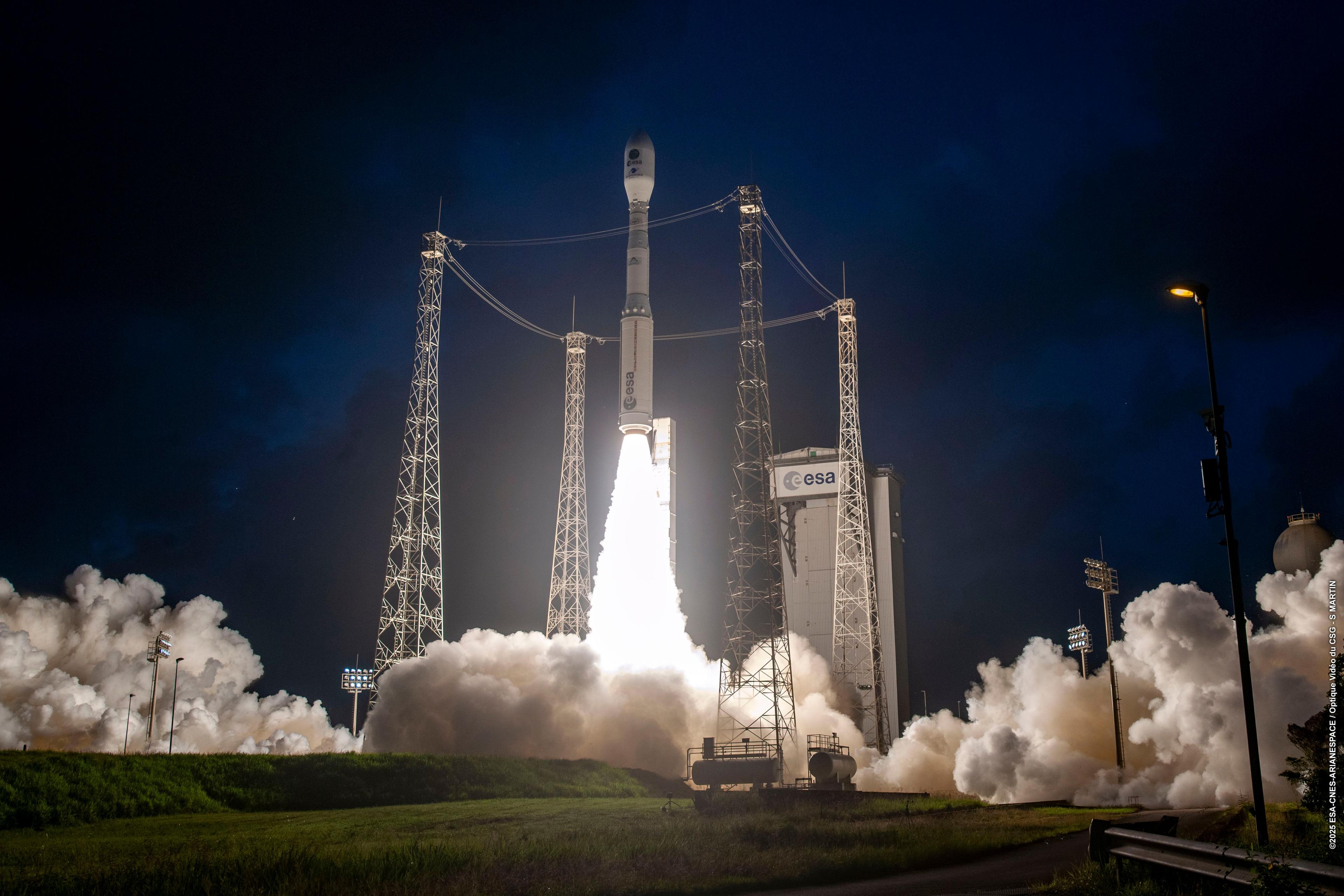
This week, the European Space Agency (ESA) successfully launched the Biomass satellite, kicking off a new era in how we monitor forest carbon from space.
Biomass is a game changer. The satellite carries a P-band synthetic aperture radar (SAR), a powerful instrument that can penetrate dense forest canopies to map their 3D structure using tomographic imaging.
For the first time, scientists will now be able to accurately estimate the volume of tree stems and branches—the main components of aboveground live biomass—from space. Biomass will provide a level of detail on trees and forests that has never been achieved before.
The mission is especially focused on wet and dry tropical forests, where thick vegetation and persistent cloud cover have long made remote sensing a challenge. Biomass is designed to track spatial patterns and changes in high-biomass landscapes, delivering essential data for carbon accounting, climate science, and forest management.
If you’d like to explore the mission in more depth or access its forthcoming data, ESA has created a dedicated information hub.
On a personal note, seeing the satellite reach orbit was unexpectedly emotional. After several early setbacks trying to get a P-band biomass mission off the ground in both the U.S. and Europe, a proposal that I co-authored with European colleagues in 2005 was finally accepted by ESA in 2006 for assessment under Earth Explorer, a set of world-class research missions to explore key scientific questions on Earth systems. The proposal moved through feasibility in 2009 and was ultimately selected as a mission in 2013.
For more than 20 years, I’ve had the privilege of working closely on Biomass—from defining measurement strategies to developing core algorithms—alongside a brilliant and dedicated group of scientists and engineers. We met regularly at ESA’s European Space Research and Technology Centre near the beach town of Noordwijk in the Netherlands, usually in the spring and fall, slowly and steadily bringing this important mission to life.
Watching the launch—even from afar—brought a rush of memories: intense debates, critical milestones, shared victories, and all of the moments in between—dinners, drinks, and late-night walks in Leiden, Noordwijk, and the many cities across Europe where our team gathered. It truly felt like a Cinema Paradiso moment—a reel of faces, ideas, and a shared belief in something that matters.
Biomass in orbit is not just a scientific milestone—it’s a deeply personal one too.
A version of this post was originally published by Sassan Saatchi on LinkedIn.
Photo credit for banner image above: ESA-CNES-ARIANESPACE


