
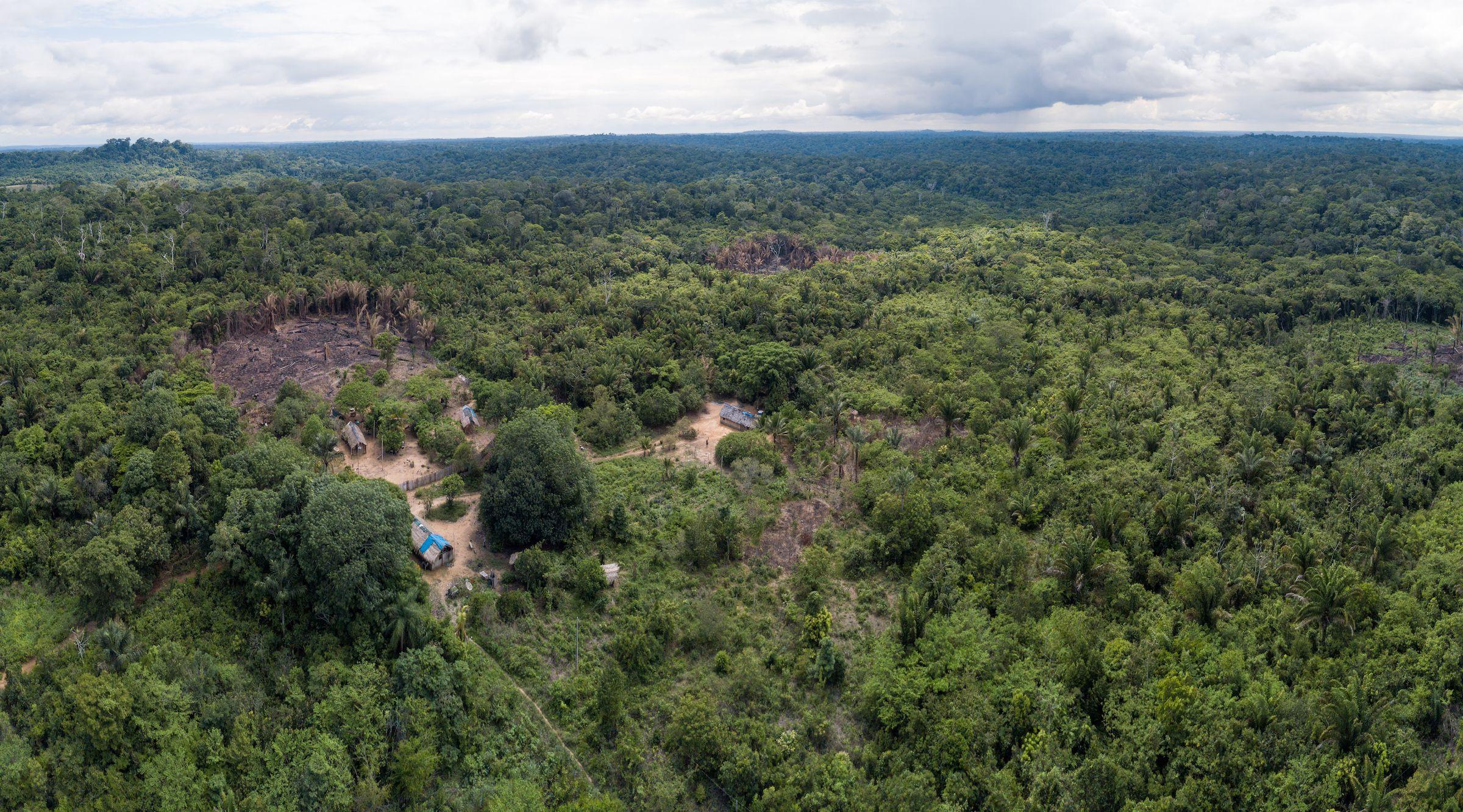
Patches of deforestation in the Amazon rainforest in Para, Brazil.
With COP30 in full swing this week in Belém, Brazil has put the Amazon, and all of tropical forests, at the center of the climate and nature agenda. The key for any breakthrough is finance – mobilizing the money now for forest communities who safeguard these precious ecosystems and maintain a deep connection to the landscape.
Among the emerging financial channels in place for tropical forests, jurisdictional REDD+ stands out for its scale and focus on mitigating the harmful effects of deforestation. JREDD+ mechanisms provide finance to countries and states that have reduced emissions from deforestation and forest degradation, in programs developed under methodologies like the Architecture for REDD+ Transactions’ The REDD+ Environmental Excellence Standard (ART TREES).
Three Brazilian Amazon states have registered or submitted programs under ART, including COP30 host Pará and the states of Acre and Tocantins. The realities of putting jurisdictional REDD+ into practice will be the topic of a CTrees event at COP30 this week.
Today, the technical foundations of JREDD are largely in place, early successes are demonstrating real impact, and the potential to mobilize billions in forest finance has never been clearer. Yet realizing the potential demands honest conversations about the barriers that remain and the coordinated action required across governments, investors, and the broader climate policy community. COP30 is a moment when the international community should move beyond acknowledging JREDD's importance to committing the policy support and demand mobilization needed to bring it to scale.
A market ready to scale
The JREDD landscape has matured since its beginnings in UNFCCC negotiations in the mid-2000s, and programs under the Amazon Fund and World Bank. As of this month, 27 jurisdictions are now participating in ART, with forests collectively covering 400 million hectares. The first JREDD program under Verra’s Jurisdictional & Nested REDD+ framework is also now under development in Chocó, Colombia.
The private sector is stepping up to purchase credits. Apple, Hess Corporation, and two Japanese airlines, All Nippon Airways and Japan Airlines, are among the recent buyers of credits from Guyana, which issued 33.5 million TREES credits in 2022, and an additional 7.1 million credits last year, making Guyana the first government to report a corresponding adjustment to the UNFCCC. Since 2023, Emergent, a nonprofit that coordinates the LEAF Coalition, has developed forward purchase agreements with Costa Rica, Ghana, Pará, and Ecuador, that together commit to more than $250 million in credit purchases. The deals represent functional pathways for channeling private finance to forest protection at the scale that matters.
According to an Environmental Defense Fund analysis, JREDD has the potential to generate up to 300 million tons of verified emission reductions annually by 2030 from jurisdictions in the ART pipeline, with revenues of $4 billion annually at forecast prices. JREDD is about putting real resources into the hands of governments, communities, and indigenous peoples who are on the frontlines of forest protection.
Areas of action: Moving from potential to practice
At a recent roundtable during Climate Week NYC, CTrees gathered leaders from governments, civil society, and the private sector to discuss pathways for scaling JREDD. The following themes emerged as critical areas requiring coordinated action as we approach COP30 and look beyond:
Early-stage finance structures are inadequate. Jurisdictions need substantial upfront capital, sometimes hundreds of thousands of dollars annually just to create credit-selling entities. And programs often require two to three years of development before registration. While initiatives like Emergent's advanced payments facility and innovative upfront capital arrangements such as from Mercuria are emerging, more structured approaches to development-phase finance are needed that match the risk profile and timeline of jurisdictional programs.
Forest degradation monitoring is a significant technical gap. The 2024 Amazon fire season impacted 3.3 million hectares of forest, causing record degradation and releasing an estimated 791 million tons of CO2. Current satellite systems only detect fires when burning areas reach 30-40 square meters, taking one to two hours—making real-time enforcement nearly impossible. Two new radar satellites, NASA-ISRO’s NISAR and ESA’ Biomass are anticipated to enable weekly monitoring of fires and other forms of degradation in tropical forests. Next-gen degradation monitoring can help jurisdictions reduce risks of reversal.
Institutional capacity building is essential but must be approached strategically. Governments’ technical expertise in MRV, safeguards, and carbon accounting is often limited, with insufficient cross-ministerial coordination. Indigenous groups and frontline communities should also be at the front and center to be empowered to protect their lands. Innovative approaches like the partnership between Silvania and Grupo Peru offer paths forward for indigenous communities to directly participate in jurisdictional programs with enhanced capacity and regulatory frameworks.
Investment products’ clarity for private capital needs dramatic improvement. Family offices and institutional investors want to support forest protection but lack clear entry points. Innovative financial mechanisms such as bioeconomy and restoration funds have the potential to bring them in. And corporate buyers need certainty about when JREDD credits will be available and what they represent.
Demand mobilization and policy support are equally critical. Supply-side improvements alone are insufficient to unlock JREDD's potential. Jurisdictional credits with strong safeguards, community benefits, and government backing offer an attractive value proposition for companies needing high-integrity credits at scale. Policy frameworks must evolve to support this market—the Article 6.4 negotiations under the Paris Agreement remain a concern, with details on permanence yet to be fully defined. The debate is fundamentally political, requiring government-level engagement to ensure that the rules emerging from international negotiations do not inadvertently undermine the jurisdictional approaches that offer our best chance at protecting forests at scale. National-level policy matters just as much: Jurisdictions need codified REDD+ strategies with strong legal frameworks so that programs survive government transitions.
Addressing political realities is fundamental. Consider the political economy in tropical forest jurisdictions. Governments seeking economic development face a constant stream of extractive opportunities, namely logging, mining, and agricultural expansion, that promise immediate investment and employment. Without JREDD demonstrating tangible revenue, forestry ministers struggle to compete with agriculture and resource ministers who can point to hundreds of millions of dollars in deals. Reframing the conversation is essential. JREDD cannot be positioned solely as a climate solution when deforestation is fundamentally linked to national security and economic stability. Ecosystem degradation threatens the agricultural systems that underpin national economies—the southern Amazon dry season has become longer and more arid, creating risks for agricultural productivity. Finance ministries and agricultural ministries must see JREDD as part of their mandate, not just an environmental program.
CTrees' role in the path forward
CTrees is working to address several of the challenges for JREDD through accessible data and technology that measures and verifies both emissions reductions and restoration efforts. CTrees’ benchmark deforestation data now covers 42 jurisdictions across 18 countries, supporting a range of jurisdictional methodologies across different standards. Our LUCA alert system provides deforestation alerts every two weeks in every forest biome globally, with weekly updates anticipated in 2026 as we integrate advanced satellite data.
CTrees has developed a customizable data platform that jurisdictions or buyers can use to evaluate potential credits or monitor the performance of JREDD programs. The pillars of CTrees’ system are annual measurement of emission reductions, near-real-time alerts, monitoring of fire and reversal risks, and comparison between jurisdictions’ reported results and CTrees’ independent data.
Making degradation data and deforestation baseline more accessible helps governments understand potential program results before committing scarce resources, a critical gap when political leaders need to justify investments against competing priorities.
CTrees’ work increasingly recognizes the interconnection between JREDD and landscape restoration. The same monitoring infrastructure that tracks deforestation and degradation can identify restoration opportunities and verify forest recovery. By providing jurisdictions with comprehensive forest landscape data, from carbon-dense primary forests requiring protection to degraded lands suitable for restoration, we help governments develop integrated strategies that maximize climate impact while supporting sustainable development.
A call for coordinated action
The road beyond COP30 requires coordination and sustained commitment. Most fundamentally, we need urgency matching the scale of the challenge. The ecosystem transformations underway in places like the southern Amazon could become irreversible within five to ten years without decisive action.
JREDD offers a proven mechanism to channel resources to forest protection at the scale required, but only if we move from potential to practice. This means:
Stakeholders with government relationships continue to engage on Article 6.4 permanence requirements.
Demand-side governments and civil society build coalitions to give corporate buyers and institutional investors clear pathways to support jurisdictional programs.
Supply jurisdictions develop frameworks for whole-of-government approaches that bring finance and agriculture ministries into alignment with environment ministries.
Market participants amplify success stories with concrete data on volumes, impacts, and use of proceeds.
Jurisdictions and supporting organizations integrate complementary approaches including landscape-scale restoration and mechanisms like the Tropical Forest Finance Facility (TFFF) to create comprehensive solutions that address both protection and regeneration of ecosystems.
COP30 in Belém should mark the moment when the global community commits to making jurisdictional REDD+ work: not just in principle, but in practice, with the policy support, demand mobilization, and political will required to protect the forests that regulate our climate and support millions of people across the tropics. The technical pieces are ready. Now we need the political courage and coordinated action to bring them to scale.
The forests cannot wait. Neither can we.


