Update Oct. 22, 11:56 a.m. PDT: A previous version of this article reported that a California-sized area of tropical forest had been degraded in the last five years. The correct time frame is the last six years.
By Daniel Melling, Rachel Kovinsky, Fabien Wagner, Ricardo Dalagnol, Aleena Ashary, Xinbo Lu
New data from CTrees reveals the full extent to which human activities have degraded tropical forests in recent years. Available in an open platform called REDD+AI (opens in a new tab), the data is the first pantropic assessment of forest degradation, activities that cause loss of trees, carbon, and other ecosystem services, without complete clearing of the forest.
Degradation activities include illegal and legal logging, with a variety of intensities across tropics, edge effects from forest fragmentation, fire that spreads into forests from nearby land clearing and deforestation, and construction of roads and trails into intact forests for logging activities, transportation, and extraction of forest woods and other commodities to the market. Governments have sought to address the climate impacts of forest degradation through programs to reduce emissions from deforestation and degradation (REDD+).
CTrees’ REDD+AI platform estimates forest degradation in every 5-meter area of evergreen tropical forest worldwide from 2017 through 2023. The product is the first pantropic dataset to attribute change to logging, fire, and road construction.
The dataset offers the most high-resolution picture to date of recent change in the tropics, with more than 30 times the spatial detail of previous pantropical products based on Landsat imagery. The CTrees data is based on images from the PlanetScope satellite constellation, provided by Planet Labs PBC and made available via Norway’s International Climate and Forests Initiative (NICFI).
How much tropical forest has been degraded?
CTrees data shows that human activities like logging, fire, and road construction degraded an average of 6.9 million hectares per year, an area equivalent to the size of Ireland, in 2017-2023. In the last six years, human activities have degraded an area of tropical forests equivalent to the size of California.
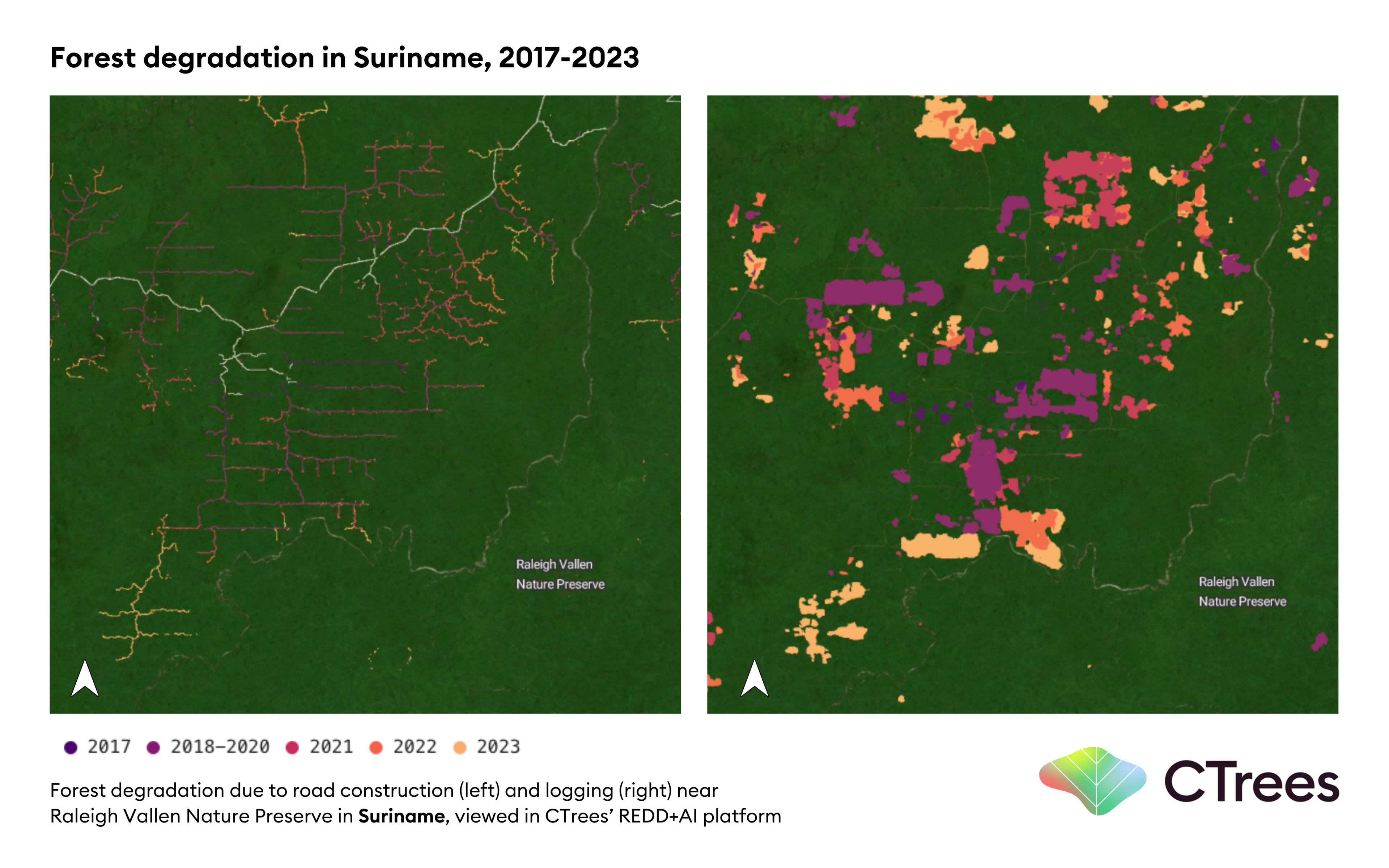
Degradation due to logging
Logging is the biggest driver of tropical forest degradation, affecting an average of 4.6 million hectares of forests every year, and making up 67% of total degradation in the study period. Logging in tropical forests can include both illegal tree removal and legal logging in concessions permitted by the government.
Degradation due to forest fire
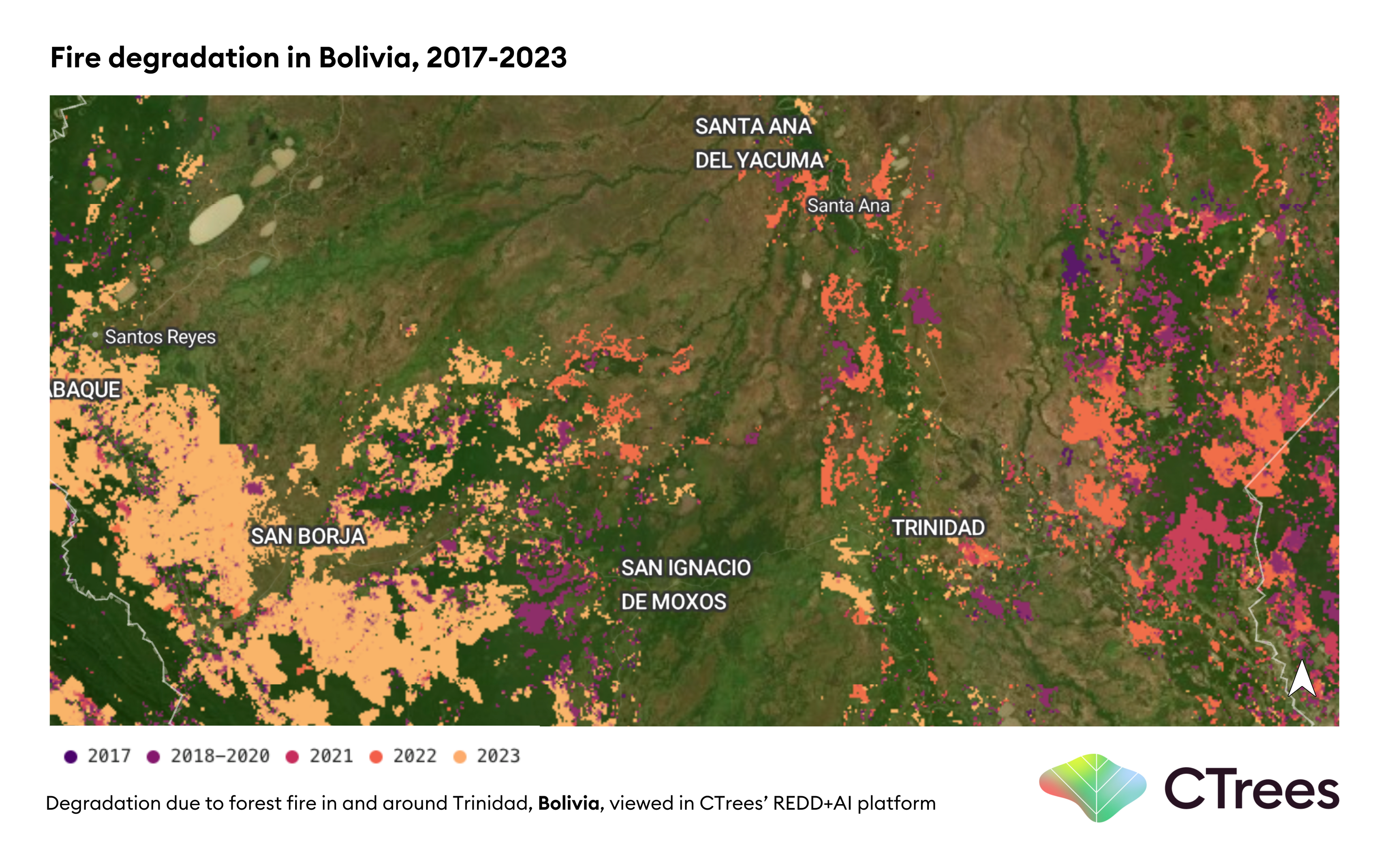
Forest fire was the second biggest driver, degrading an average of 1.7 million hectares of tropical forest every year, and making up 24% of total degradation. Notably, fires do not occur naturally in the tropics. Fires in the tropics are typically set by individuals seeking to clear land for agricultural purposes, but will often expand into intact forests, especially those suffering from drought.
Degradation due to road construction
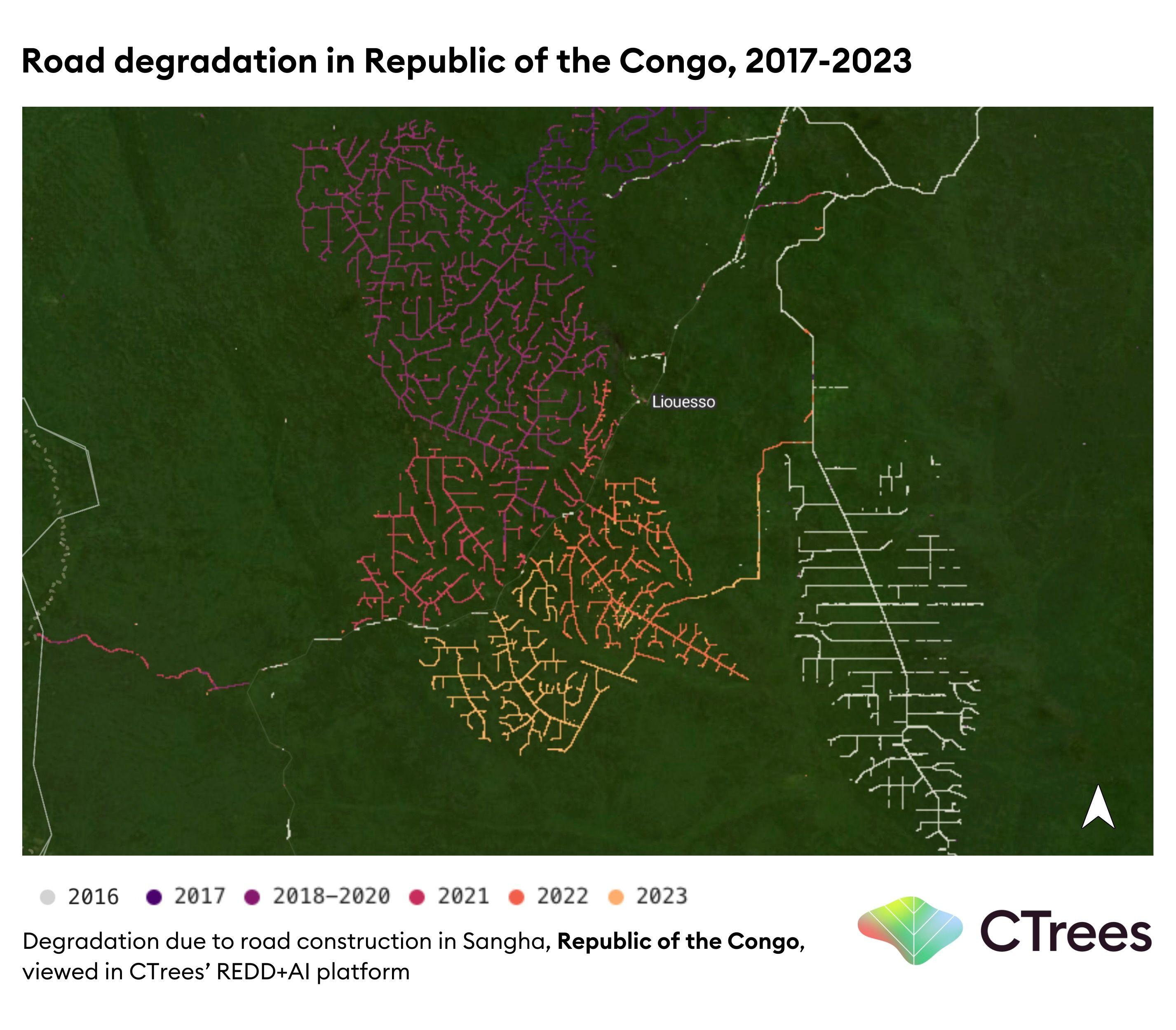
Road construction was responsible for an average of 603,000 hectares of tropical forest degradation every year, making up the remaining 9% of total degradation. Annual road construction in tropical forests corresponds to roughly 421,000 km of roads in length being built every year, equivalent to the length of the United Kingdom’s entire road network.
Roads detected by REDD+AI are often not mapped in official datasets. Some roads detected by REDD+AI are small trails in the middle of forest used for logging activities, or roads in the middle of tree plantations. While the area of forest degradation due to road construction is smaller than degradation due to fire or logging, roads are typically the precursor to more significant forest disturbances such as selective logging, mining, or conversion of forest to agricultural land.
Tree cover loss versus degradation
REDD+AI also measures tree cover loss, defined as areas that have undergone the complete removal of trees, also called clear-cutting, in natural or planted forests. The term 'tree cover loss' is preferred over 'deforestation' because the latter is generally restricted to the permanent conversion of forest areas to non-forest uses, such as agriculture or urban development, and must follow the area definition of forests (> 0.5 hectares), which is 200 times larger than the resolution of REDD+AI. Areas of tree cover loss smaller than the definition of forest may be considered part of forest degradation. REDD+AI may underestimate tree cover loss for years 2017-2020 due to the six-month cadence of NICFI data during this period (the issue does not affect REDD+AI estimates of forest degradation for logging, fire, and road construction).
In 2023, the area of tree cover loss from land clearing in tropical forests was about twice the area of forest degradation. REDD+AI data show that tree cover loss in 2023 made up 16.7 million hectares across the tropics, whereas degradation covered 6.9 million hectares.
Which countries experienced the most tropical forest degradation?
Combining all three degradation drivers, Brazil saw the greatest average annual area of forest degradation from 2017 to 2023, followed by Indonesia and Malaysia. A breakdown by driver shows which countries experienced the most degradation due to logging, fire, and roads:
After Brazil, Indonesia had the second highest average annual area of forest degradation due to logging, with 767,000 hectares degraded per year. Logging made up 84% of forest degradation in Indonesia in 2017-2023. Malaysia experienced more than 608,000 hectares of degradation due to logging on average each year.
After Brazil, forest fires had the greatest effect in Myanmar, with almost 250,000 hectares of forest degraded on average in 2017-2023. Bolivia saw more than 200,000 hectares of forest degraded by fire each year in the study period, with a notable spike in 2023.
Brazil experienced the greatest impact from road construction during the study period, with 236,000 hectares of forest degraded on average each year. Road construction degraded 123,000 hectares of forest on average each year in Indonesia, equivalent to more than 86,108 km of road, the length of Argentina’s road network. In Malaysia, road construction degraded 46,000 hectares of forest on average, equivalent to more than 32,000 km of road, the length of Morocco’s road network.
How much forest degradation and deforestation did Brazil experience?
Brazil saw the greatest area of degradation across all three categories (logging, roads, fire). Logging degraded 1.2 million hectares of Brazilian rainforest on average every year in 2017-2023. Logging steadily increased from 2017 to 2022 in Brazil, hitting a peak in 2022 with over 1,575,300 hectares of forest degraded.
Fire affected 516,000 hectares of forest on average annually in Brazil. Road construction degraded 237,000 hectares of forest on average annually during the same period, equivalent to more than 165,000 km of road, similar to the length of Tunisia’s road network. Brazil made up more than half the degradation from road construction across the entire global tropics.
In Brazil, REDD+AI data show a 27% reduction in tree cover loss in 2023 versus 2022, with 3.4 million hectares of tree cover loss in 2022, and 2.5 million hectares of tree cover loss in 2023. The rate of reduction follows the same tendency as PRODES data, the official source managed by INPE, Brazil's space agency, and used by the Brazilian government for reporting deforestation. PRODES recorded a reduction of 22% in 2023 versus 2022.
REDD+AI records two to three times higher amounts of tree cover loss annually because its AI algorithm works at ~5 m spatial resolution, whereas PRODES uses lower resolution satellite images, for a final resolution of ~250 m. A portion of PRODES’ mapping process is manual and validated visually, which limits the resolution that can be processed within a yearly time frame. Even with this difference, similar annual tree cover loss changes patterns are observed.


