
Last month, CTrees took to New York for Climate Week, the annual gathering of experts, politicos, financiers, media, and activists aimed at activating capital, culture, and policy to address climate change.
With the U.S. federal government in retreat on climate policy, one might have expected a more timid tone in New York this year. But the Climate Group, a nonprofit that organizes the week’s public calendar, reported 2025 as the biggest Climate Week yet, with more than 1,000 registered events. Climate action is still alive. And in the conference rooms, roundtables, and hallways, conversations were focused on nuts-and-bolts solutions.
CTrees added to the agenda with two closed-door roundtable discussions, on forest restoration and jurisdictional REDD+; a panel on U.S. tree-level analytics, sponsored by the Doris Duke Foundation; and speaking roles at panels on REDD+ baselines and technology for natural climate solutions. All three panels were hosted at the Nature Hub, a central point for discussion on finance for forests and ecosystems, organized by the Nature4Climate coalition.
For forests, Climate Week lit new pathways to large-scale finance, with the Forest & Climate Leadership Partnership and Forest Declaration Assessment presenting priorities for public and private investment. Brazil’s leadership of annual UN climate talks also stood out, with Brazilian voices across government, private sector, and civil society sharing objectives for COP30 in Belém. And U.S. leadership in science and technology continued to shine, with new initiatives taking shape like the GHG Coalition, a collaboration to accelerate technologies for measuring greenhouse gas emissions and removals from all sectors.
Following are six areas where CTrees contributed to discussions in New York, joining efforts to protect ecosystems and build investment in forest economies.
1. Providing independent data to accelerate jurisdictional REDD+
Large-scale issuances are around the corner for jurisdictional REDD+ carbon credits. More than 26 states and countries are now developing JREDD+ programs under the Architecture for REDD+ Transactions’ TREES standard, and the first Verra Jurisdictional & Nested REDD+ program is under development in Chocó, Colombia.
But matching demand to supply is needed to scale the market. Climate Week highlighted the role of initiatives like LEAF Coalition and Race to Belém in educating and organizing corporate buyers. Governments are likewise getting involved, with the UK, Kenya, Singapore, France, and Panama building a coalition to grow private sector participation in carbon markets.
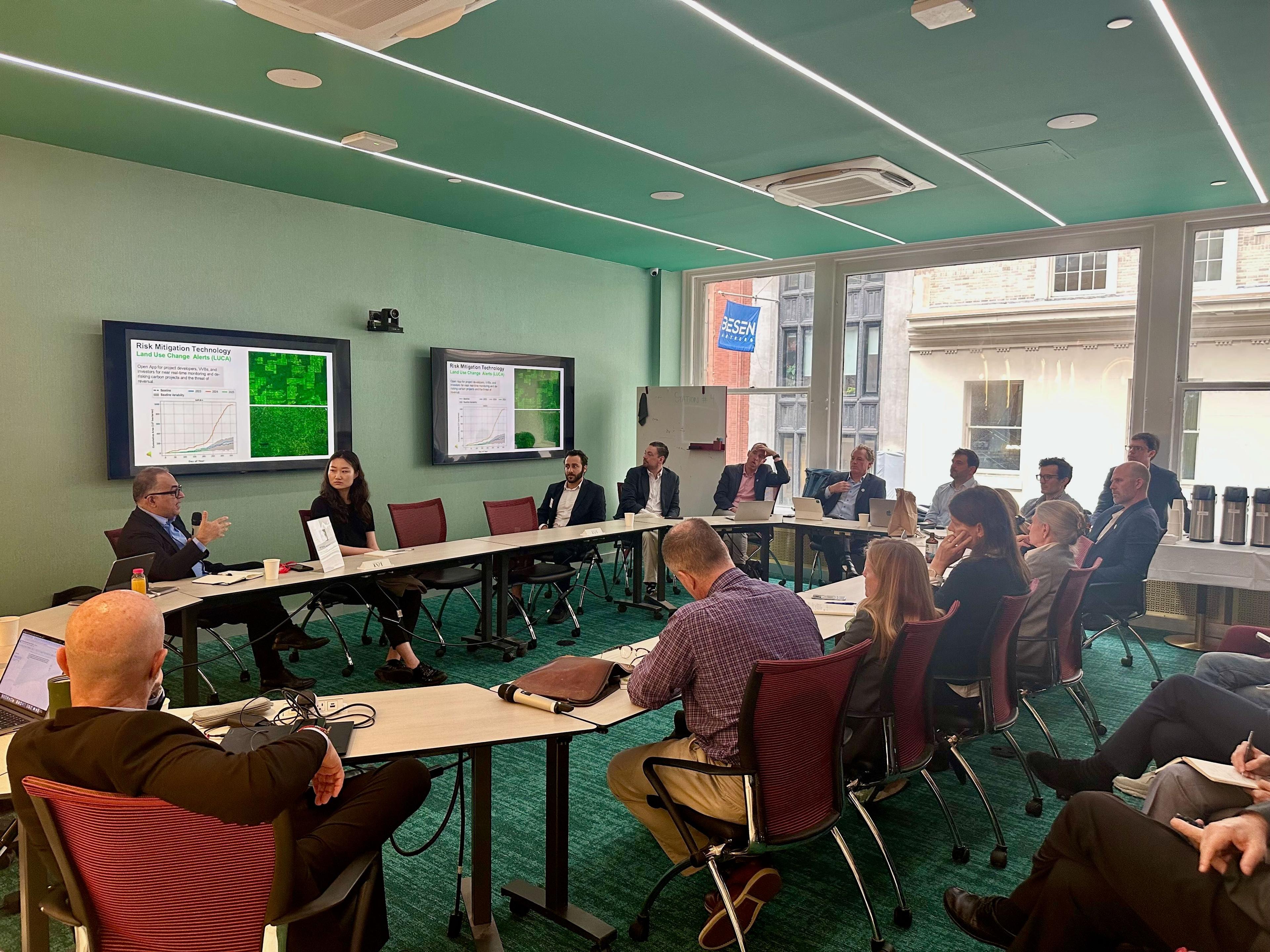
CTrees roundtable on forest restoration. Credit: Daniel Melling
At Climate Week, CTrees convened more than 20 JREDD+ leaders for a closed-door roundtable to discuss challenges for growing the market, including building institutional capacity in supplier countries, monitoring the effects of forest degradation, and managing political economies that favor agricultural expansion.
To boost private sector demand, CTrees has developed MRV tools for companies to independently verify emissions performance of JREDD programs with rigorous, scientific data. On the supply side, CTrees is also working to make its LUCA alert system and degradation monitoring tools available to interested jurisdictions.
2. Valuing standing forests as natural infrastructure
While JREDD+ offers finance for jurisdictions that reduce deforestation, countries that protect standing forests still receive few financial rewards for their efforts.
Among positive Climate Week announcements, Brazil’s President Luiz Inacio Lula da Silva announced a $1 billion commitment to the Tropical Forest Forever Facility, an innovative financial mechanism that would provide stable payments to countries that maintain tropical forests.
Brazil’s contribution is the first response to a call for $25 billion in public investment in TFFF, designed to attract $100 billion more in private capital and operationalize the fund. With COP30 approaching, pressure is now on for other countries to come forward. Look to Norway, Germany, France, United Kingdom, and United Arab Emirates, Indonesia, and Singapore as potential contributors.
At a Nature Hub panel, Wildlife Conservation Society expert Daniel Zarin described TFFF as filling a gap for “preventive care” for tropical forests, compared to “urgent care” delivered through REDD+ payments, and “recovery” via restoration finance.
As efforts to value intact forests gain speed, CTrees is providing data to WCS for its High Integrity Forest Investment Initiative (HIFOR), which aims to channel finance to protect standing forests as critical natural infrastructure. CTrees will be closely following TFFF as a new source of finance as COP30 approaches.
3. Scaling “low-friction” natural climate solutions with innovative digital MRV technology
In the decade since the Paris Agreement was signed, limited finance has gone to protecting and restoring ecosystems, even as scientists recognize nature-based solutions’ massive potential to address climate change.
At a Nature Hub session on technology, Bronson Griscom, VP of natural climate solutions at Conservation International, offered a diagnosis: too much “friction” in implementation, including high costs, concerns over projects’ carbon accounting, the need for change in culture and livelihoods, and bespoke project design.
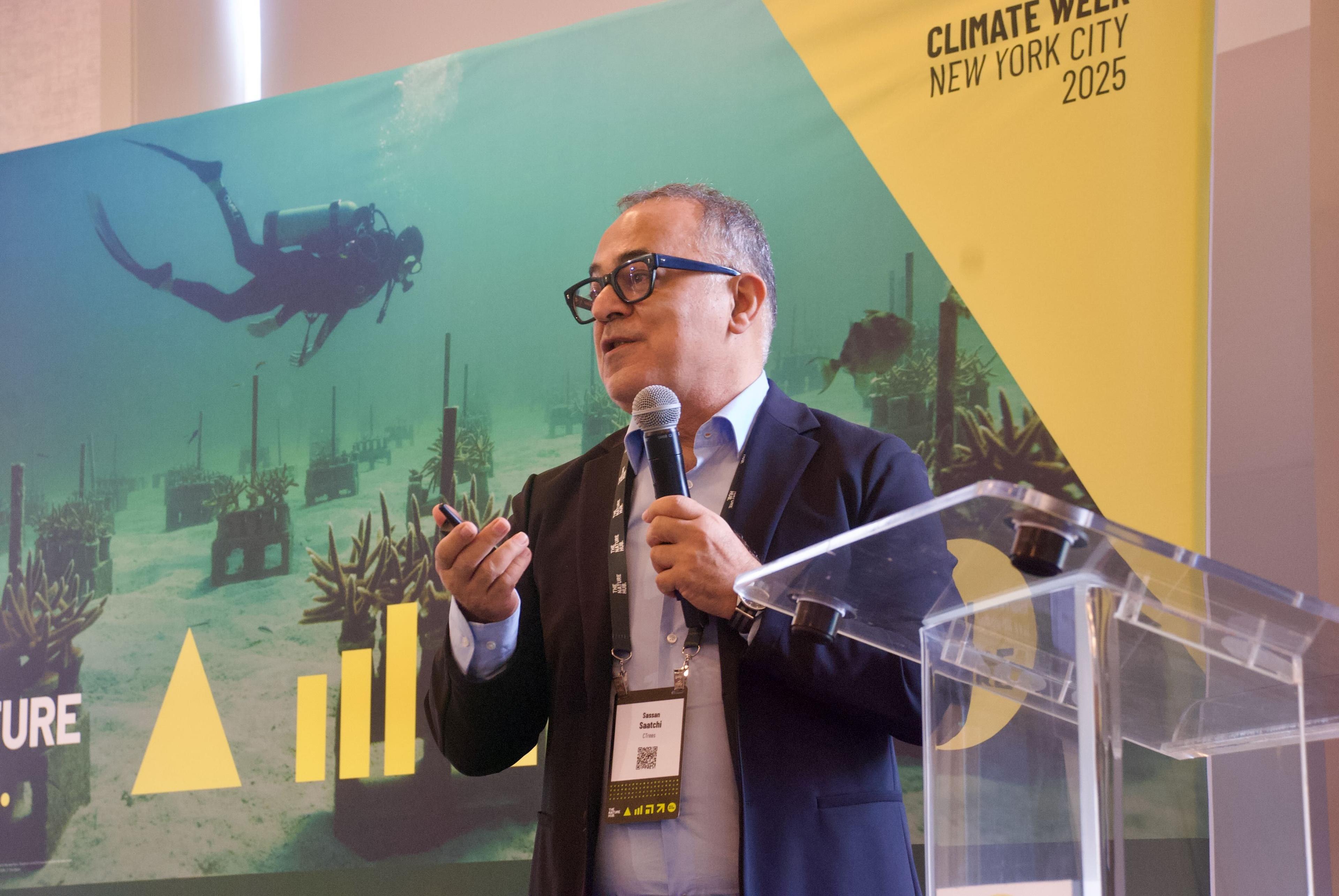
Sassan Saatchi speaks at a Nature Hub session on technology for nature-based solutions. Credit: Daniel Melling
CTrees is now working with CI to develop two new, “low-friction” solutions: liana-impacted forest treatments (LIFT), a program to accelerate regrowth in degraded tropical forests by thinning woody vines; and Treeline, an effort to incentivize farmers to plant trees at field boundaries. CTrees is supporting both initiatives with advanced data solutions to monitor and verify pilot projects’ carbon impact and improve methodologies.
4. Supporting rural investment with tree-level data
In the tropics, where agriculture is the predominant driver of deforestation, shifting towards sustainable production is essential.
In positive news at Climate Week, the Brazil Restoration and Bioeconomy Finance Coalition announced $4.5 billion in investment pledges for ecosystem restoration and nature-positive enterprises. The coalition recognizes the value of cutting-edge science to measure impact and drive scale.
To quantify and value the carbon impact of forest products, companies need access to high-quality, credible information. Private sector speakers at CTrees’ session on the U.S. forest economy emphasized the value of public data resources.
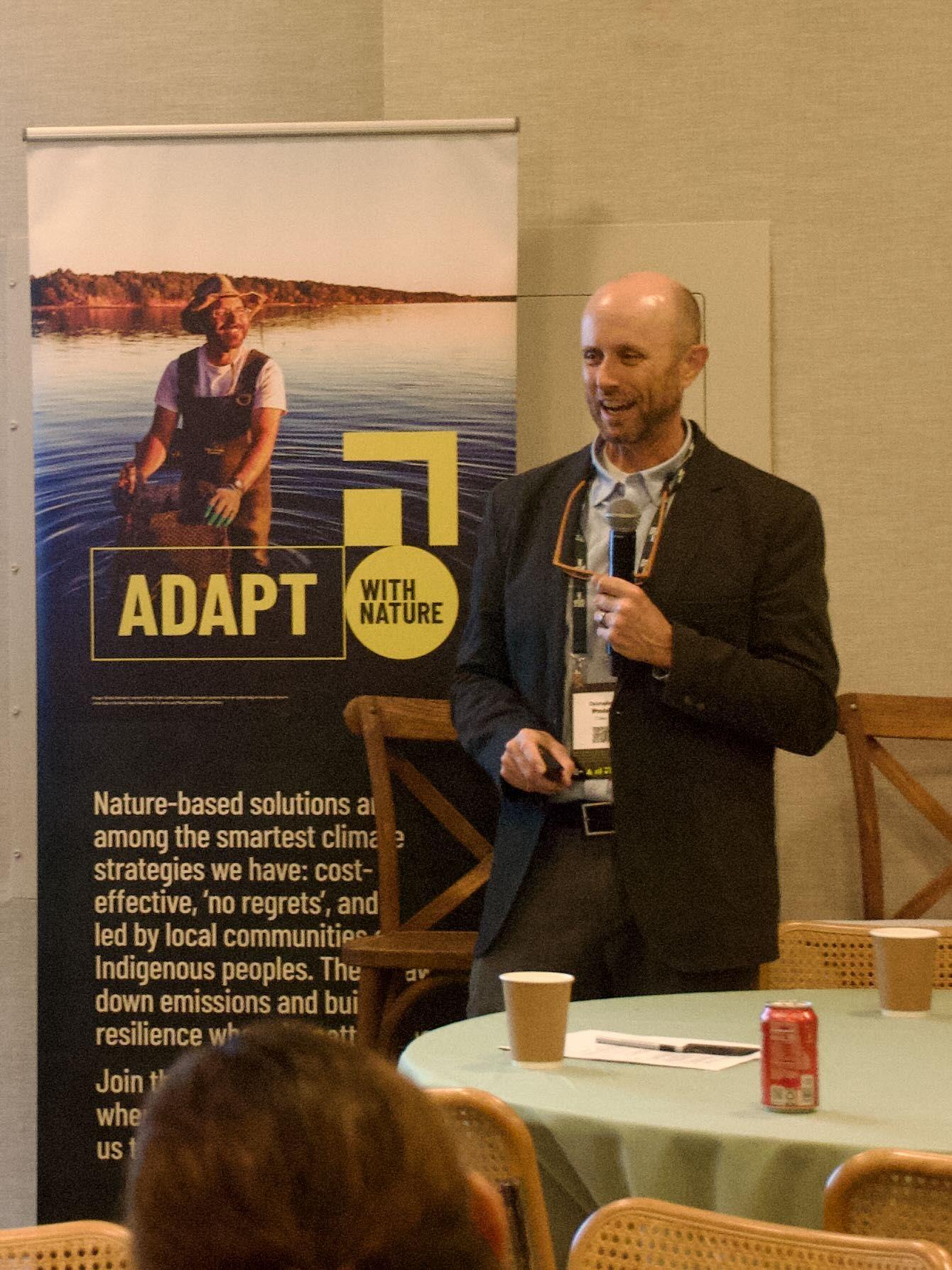
Chris Woodall leads a Nature Hub panel on digital MRV for a tree-based U.S. economy
CTrees is now working to build out public data infrastructure that applies cutting-edge technology like tree-level monitoring. Before Climate Week, CTrees was announced as a founding member of the GHG Coalition, which aims to coordinate technical initiatives across U.S. sectors to develop the country's technology for measuring carbon emissions and removals.
5. Quantifying fire impact in the Amazon basin
Damage from historic fires across the Amazon basin last year was a recurring point in dialogues in New York, with scientists detailing how the effects of deforestation and global warming could result in half of the Amazon rainforest drying into savannah by midcentury.
“We cannot reach the tipping point. We are getting close,” warned Garo Batmanian, general director of Brazil’s Forest Service, in a Nature Hub panel.
Emissions from forest fires in the Amazon basin last year totaled almost 800 million metric tons of CO₂, Sassan Saatchi noted in a press conference for the Forest Declaration Assessment 2025 report, released this week. The amount is more than the total greenhouse gas emissions of some of the major industrial countries in Europe, such as Germany.
At COP30, CTrees will share more insight on the emissions impact of the fires for all the Amazon basin countries, as part of a release of global data on land carbon emissions and removals in the Jurisdictional MRV tool.
Looking ahead, CTrees is updating its tools to monitor the effects of fire with data from two new radar satellites, ESA’s Biomass and NASA-ISRO’s NISAR mission, that launched this year. The satellite data will improve CTrees’ LUCA alert system for rapid response, and allow for more accurate attributions in our forest activity data products.
6. Affirming nature’s role in carbon markets
2025 saw more debate in New York about the role of nature-based projects in carbon markets. This year’s flash point being a draft standard on non-permanence and reversals issued by the supervisory body for the Paris Agreement Crediting Mechanism, also known as Article 6.4 (for its placement in the 2015 agreement text).
To many experts, the draft’s stringent requirements for risk management and monitoring would have excluded nature projects from any carbon market governed by the standard. CTrees’ Sassan Saatchi was one of more than 150 scientists to sign a September 9 letter to the supervisory body sharing concerns.
This week, the supervisory body adopted a standard with modifications that would place more responsibility on individual methodologies to address durability risks.
As debate continues, CTrees is working with market leaders to improve the integrity of nature-based credits.
In June, Verra’s methodology for REDD+ became operational in the Brazilian states of Para and Mato Grosso, backed by CTrees maps of historical deforestation. CTrees is providing data for 34 more jurisdictions in the program. Across improved forest management, forest restoration, blue carbon, and other methodologies, CTrees is developing rigorous, scientific data products to monitor and verify carbon outcomes.
What issues are you following?
With COP30 starting on November 10, CTrees will be in Belém to continue learning from the forest science and policy community, share insights from our scientific data, and develop partnerships to advance natural climate solutions. To get in touch with our team, please contact info@ctrees.org, or fill out our contact form.


