

Protecting tropical forests may be one of the highest impact climate solutions, but securing finance at the scale and speed needed to ensure their long-term protection is no easy feat.
At a London Climate Action Week event last month, CTrees brought together expert panelists and more than 130 attendees to discuss advances in results-based policy and finance for tropical forests.
How to address the gap in finance for tropical forests has taken on greater urgency this year as Brazil prepares to host COP30 in Belém in November.
The event provided a public forum to discuss jurisdictional REDD+ (JREDD) and the Tropical Forest Forever Facility (TFFF), two financial mechanisms designed to deliver the large-scale financing needed to reduce deforestation and protect forests across the Amazon Basin, Central Africa, and Southeast Asia.
Advancing a jurisdictional approach to forest finance
JREDD, a jurisdictional approach to reducing emissions from deforestation and forest degradation, was first introduced into the official negotiations of the UN Framework Convention on Climate Change (UNFCCC) in 2007.
Nearly 18 years later, many JREDD projects are moving from paper to practice, noted speakers during the first panel discussion of the event.
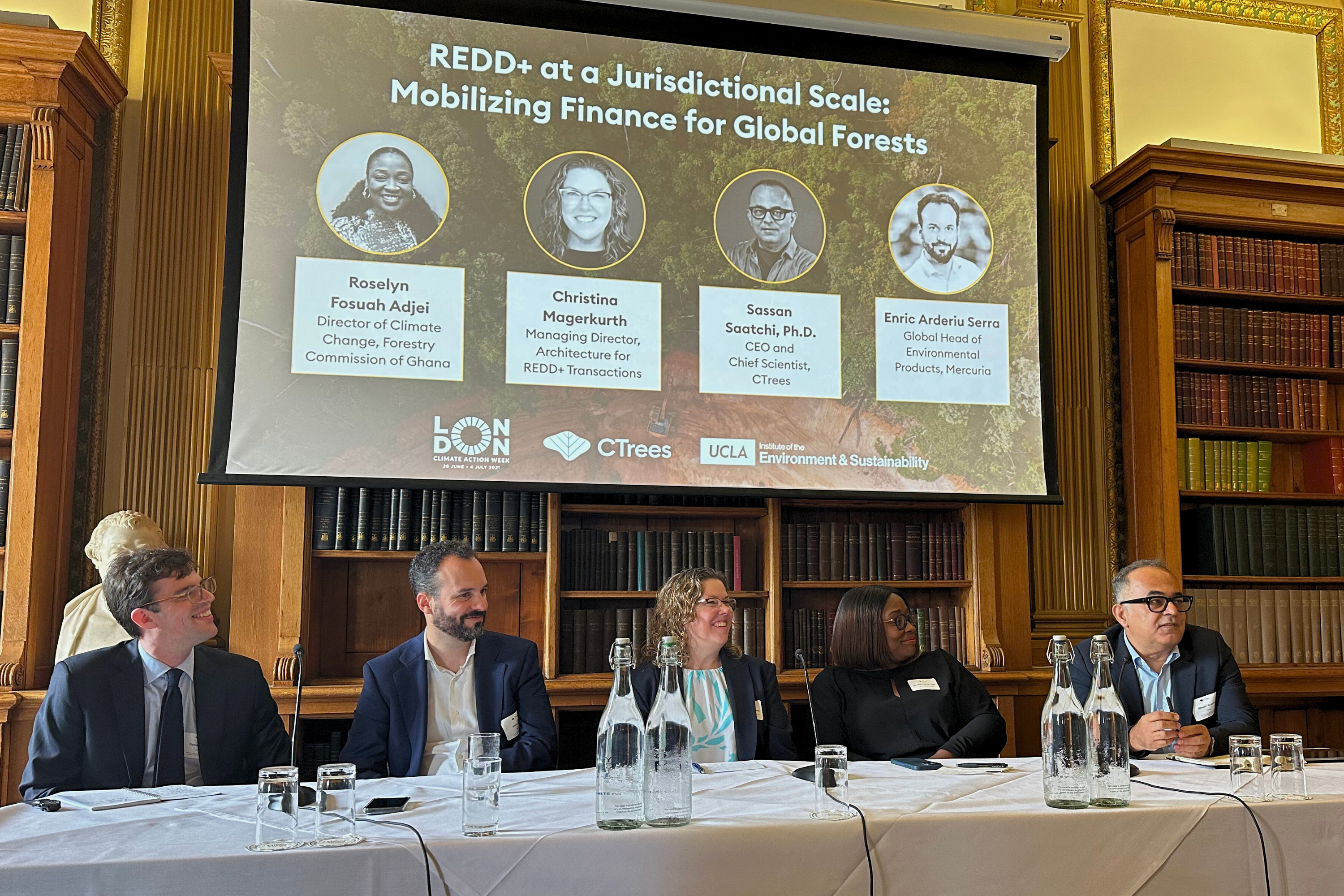
[From left to right] Daniel Melling (moderator) and panelists Enric Arderiu Serra, Christina Magerkurth, Roselyn Fosuah Adjei, and Sassan Saatchi.
Christina Magerkurth, managing director at Architecture for REDD+ Transactions (ART), said that 25 jurisdictions are now registered with the standard. Four of those jurisdictions are going through a final validation and verification process prior to issuing credits.
“We’re at an exciting time for jurisdictional REDD,” said Magerkurth. “A lot of things that we’ve been seeing in theory over the last few years are finally coming to fruition.”
Ghana is one of the countries nearing the end of ART’s audit process.
“We call ourselves a living lab,” said Roselyn Fosuah Adjei, climate change director at the Forestry Commission of Ghana, who emphasized the importance of inclusive governance and community participation.
Ghana’s benefit-sharing plan would deliver 69% of carbon payments directly to local communities, Adjei said. The finance is meaningful for Ghanaian farmers who are already noticing shifts in rainfall alongside other climate impacts.
“Climate change is already happening,” she said. “We cannot just be ingrained in the things of the past to define the future.”
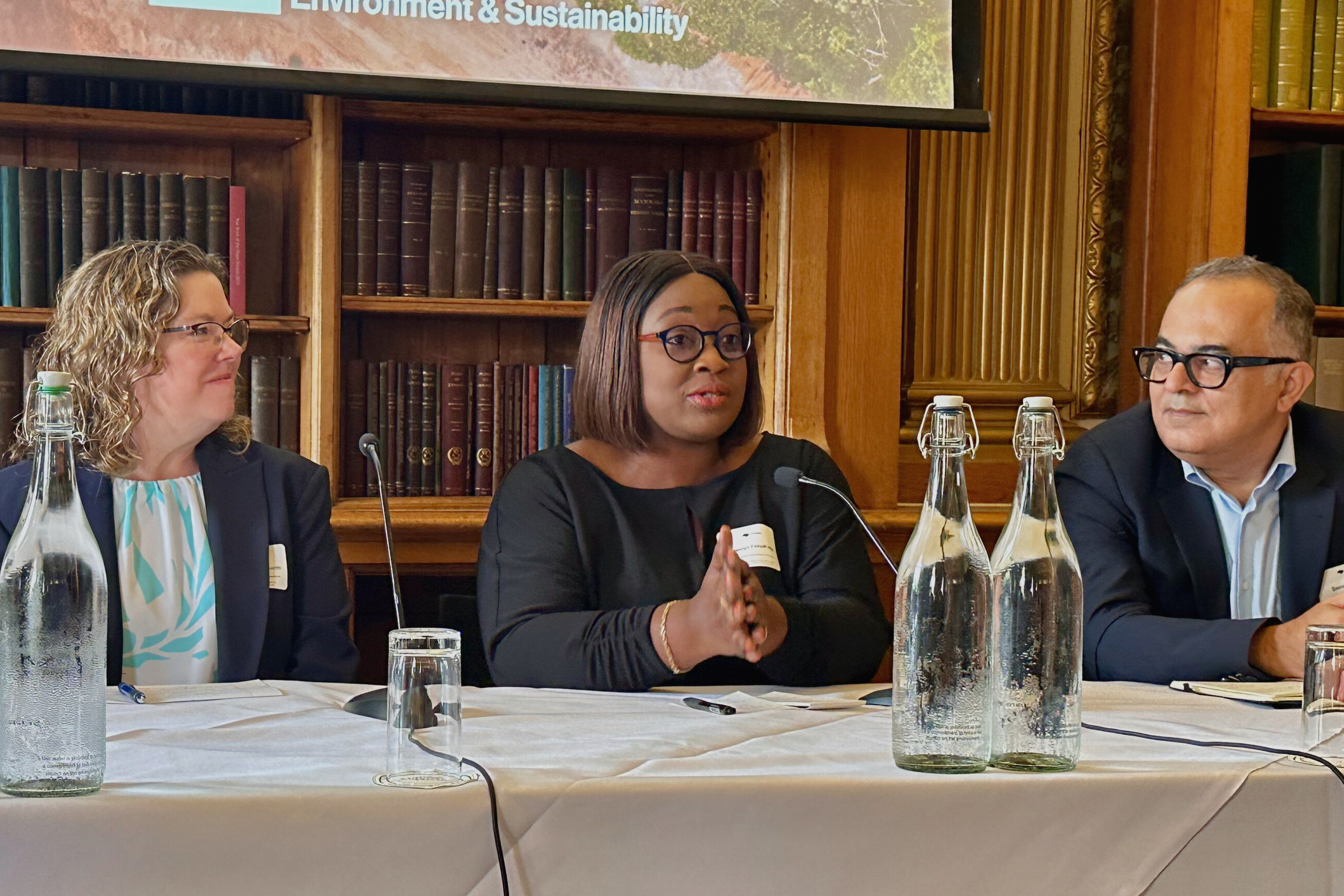
Roselyn Fosuah Adjei discusses Ghana’s experience navigating jurisdictional REDD+ over the last 18 years.
Enric Arderiu Serra, global head of environmental products at Mercuria, asked attendees to consider a role for the private sector in JREDD programs—beyond just purchasing credits.
Serra shared details about Mercuria’s upfront investment approach to help jurisdictions prepare for carbon market participation and introduced Race to Belém, an initiative launched in January to involve corporate buyers in JREDD on the road to COP30.
“Transparency is essential,” said Serra. “From the beginning, designing programs where the private sector works with [governments] in a very transparent manner is the only way that this is going to be successful.”
The need for greater transparency and trust was echoed by fellow panelists—including CTrees’ CEO and chief scientist, Sassan Saatchi.
According to Saatchi, independent scientific data is urgently needed to address deforestation and advance natural climate solutions globally.
Organizations like CTrees are proving that high-quality, low-cost digital MRV can help jurisdictions looking to participate in JREDD programs increase the scale and speed of their mitigation efforts.
"We need to stick with the message,” said Saatchi. “We need to reduce carbon and we need to stop deforestation and preserve forests."
Introducing a new source of funding to protect tropical forests
A second panel at the event provided updates on the Tropical Forest Forever Facility (TFFF), a financial mechanism first introduced by Brazil at COP28 and set to launch at COP30.
The initiative aims to create an endowment that directly pays forest countries per hectare of standing tropical forest. If successful, TFFF could mobilize up to $4 billion annually for tropical forest protection, nearly triple the amount of international financing available today.
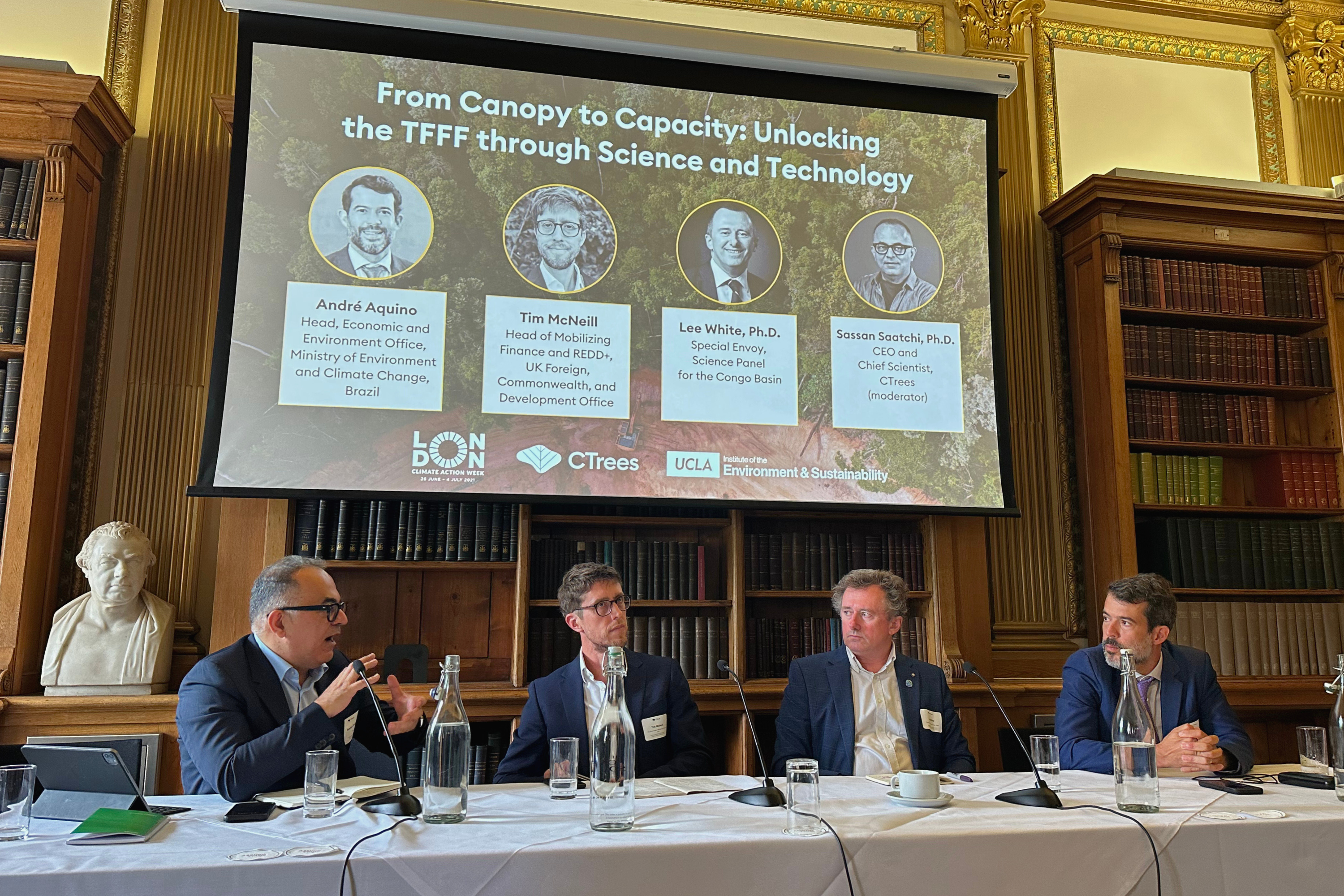
[From left to right] Sassan Saatchi (moderator) and panelists Tim McNeill, Lee White, and André Aquino.
Brazil’s leadership in advancing TFFF drew praise from Tim McNeill, head of mobilising finance and REDD+ for the UK Foreign, Commonwealth, and Development Office.
“We talk about creating innovative and ambitious mechanisms all the time, but Brazil is actually doing it,” said McNeill. “The key to this is also having strong governance mechanisms and a very inclusive, transparent approach going forward.”
Still, panelists warned that TFFF should complement, not replace, existing programs and policies directing funds towards forest conservation.
After all, an estimated $460 billion per year is needed to protect and restore the world’s forests by 2030.
“We need a menu of options,” said André Aquino, head of the Economic and Environment Office within Brazil’s Ministry of Environment and Climate Change. “The TFFF is supposed to generate long-term, sustained financing for national policies."
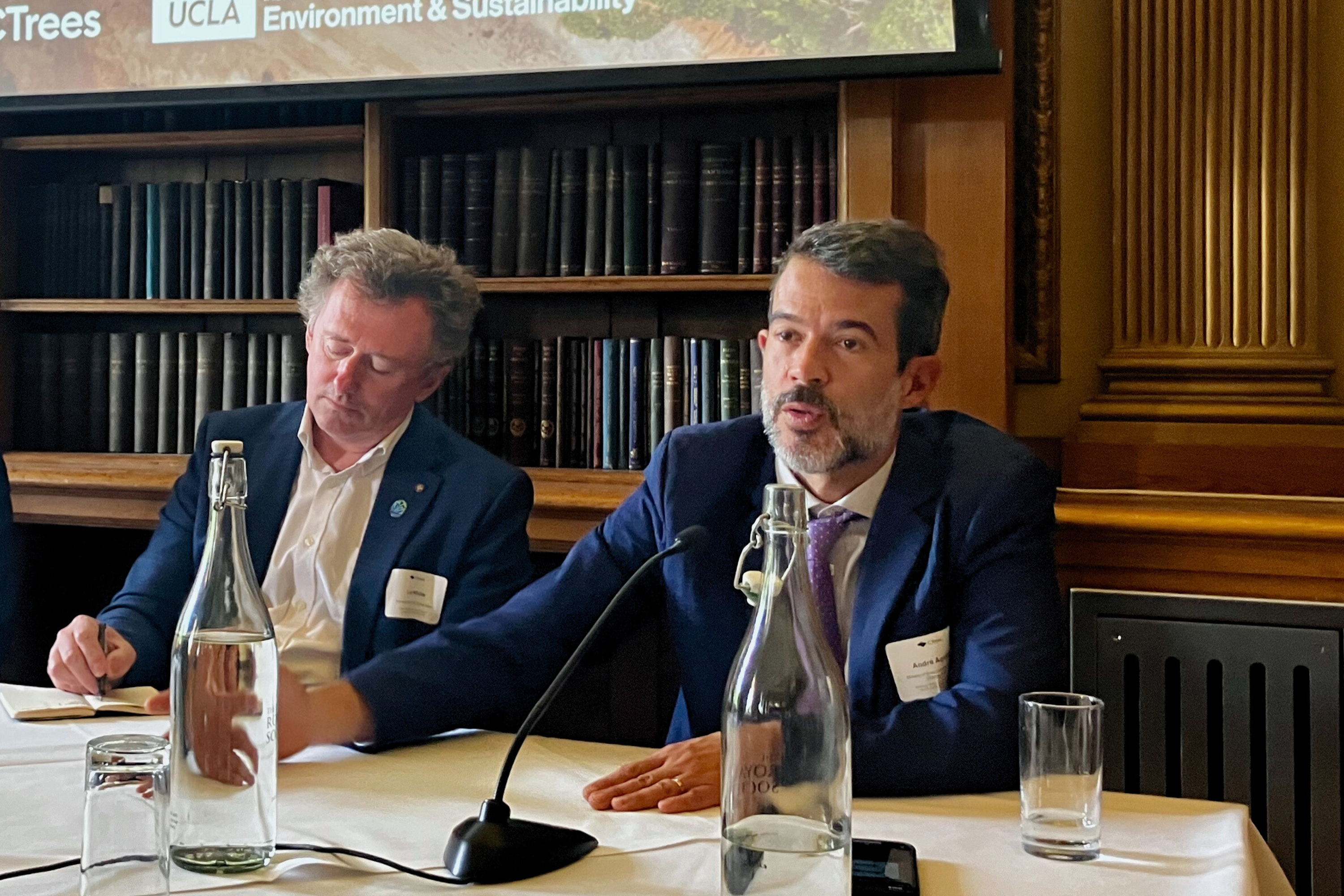
André Aquino provided insight into the Brazilian government’s perspective on TFFF.
Any new forest finance mechanism must also recognize the root causes and scale of tropical forest loss, which continues to increase globally.
“We absolutely will lose the fight against climate change if we don’t preserve the world’s forests, especially tropical forests,” said Lee White, special envoy for the Science Panel for the Congo Basin and a member of CTrees’ board of directors.
“We desperately need a mechanism that actually rewards tropical forest countries for preserving these forests that are critical to the world."
Sustaining momentum beyond COP30
The London Climate Action Week event elevated diverse voices looking to advance the next generation of solutions for tropical forests.
Across both panels, speakers recognized the challenges associated with building durable programs that reduce deforestation and forest degradation, and agreed on the need for extensive community engagement, cross-sector collaboration, and innovative funding mechanisms.
Independent scientific data will also play a critical role in monitoring these initiatives, helping ensure greater transparency and building trust among stakeholders.
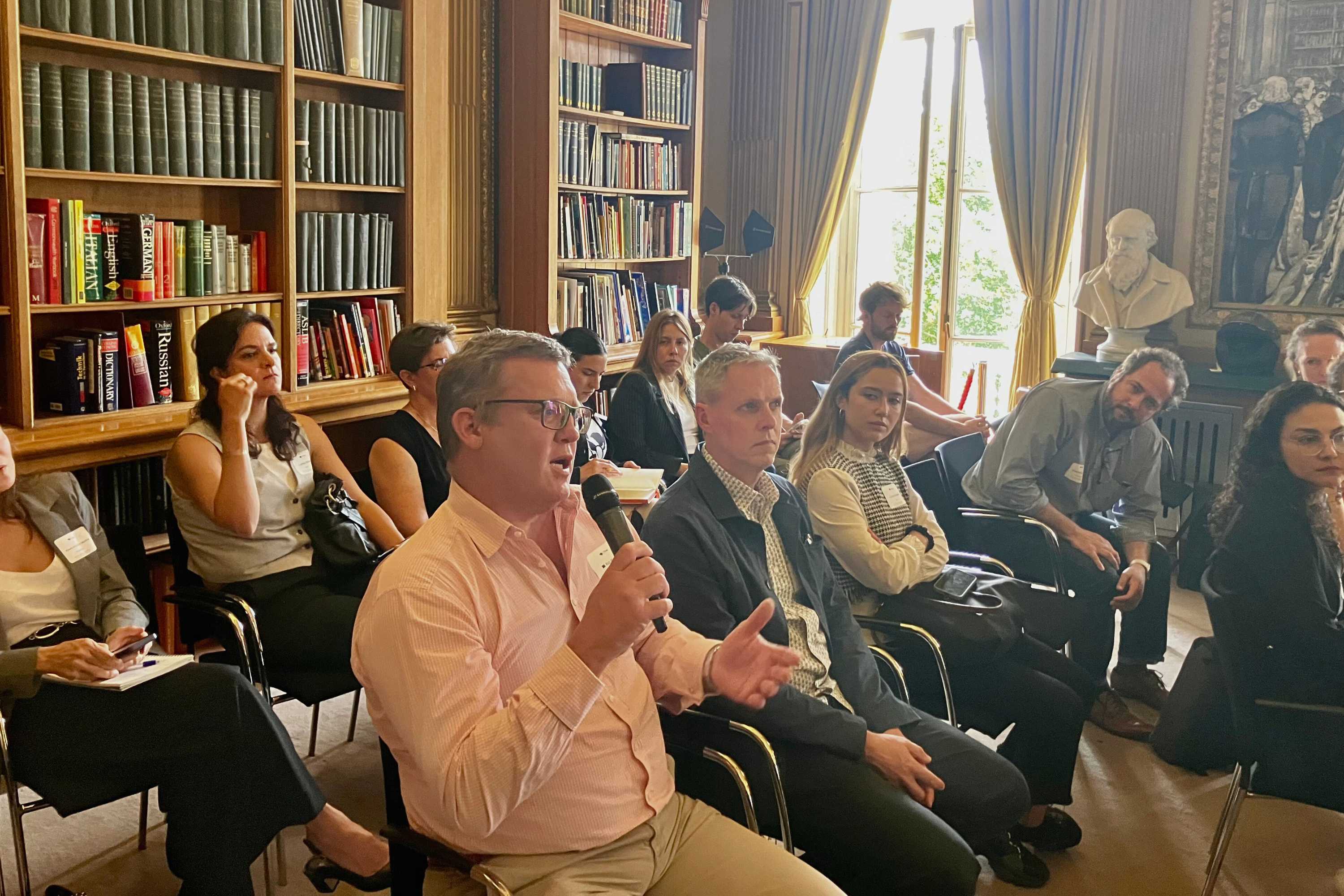
Attendees ask questions at a panel during CTrees’ inaugural London Climate Action Week event.
As COP30 approaches, results-based programs like JREDD and TFFF seek to deliver the large-scale funding urgently needed to protect tropical forests for future generations.
The challenge, according to many of the panelists, will be to sustain the commitment to action and impact beyond Belém.
“Let’s do something the day after COP too,” urged Magerkurth. “Let’s not lose the momentum.”


