

Chris Woodall, CTrees’ director of US forest science and policy, spent more than 20 years as a scientist in the US Forest Service.
In his previous role as a scientist with the US Forest Service, Chris Woodall, CTrees’ director of US forest science and policy, helped build the accounting infrastructure for measuring and reporting forest carbon in the U.S.
Now, Woodall argues that the system has become outdated: out of step with the latest advances in technology and lacking the flexibility to meet the needs of forest managers, landowners, and communities seeking to implement nature-based solutions that deliver benefits beyond carbon.
In a commentary published this week in One Earth, Woodall writes that advances in remote sensing and AI have made a new digital architecture possible, one that finally makes every tree count.
I sat down with Woodall to discuss insights from his essay.
You helped design the scientific approaches for the U.S. to measure its forest carbon in the years following the Paris Agreement. How have times changed, and why has this legacy system become insufficient?
The foundational system we built was designed for a very specific purpose: static, national-scale bookkeeping to empower the implementation of the Paris Accords.
I served as the co-chair of the interagency technical working group on land sector carbon inventories for President Obama’s Council of Environmental Quality, while also leading the annual development and submission of the U.S. national inventory report for forests to the UNFCCC. Throughout that multi-year deliberation, I always saw our accounting standards as “technical triage” to just get elected officials to the negotiating tables.
The system’s job was to roll up all of the nation's forest carbon into one number for international reporting purposes. At the time, it was built on the best science and technology we had available, which was primarily coarse land-use data and periodic, plot-based inventories.
We're now asking this same legacy framework to do incredibly dynamic, high-stakes functions that it was never built for: verifying carbon credits on specific parcels of land, guiding climate adaptation in the face of escalating risk, ensuring supply-chain traceability to international regulations, and integrating carbon with other ecosystems services.
The legacy system has become insufficient because there's now a fundamental mismatch between its original design and these new demands. As I describe in the commentary, it’s essentially an 'architecture of inflexibility.'
We’re trying to use a system built for static, national ledgers to manage a living and constantly changing ecosystem, and that’s why it’s buckling under the pressure.
I knew the accounting approach would need to be rebooted once science and technology had a chance to mature. Ten years later, I think we’ve arrived at that point.
What do governments, forest managers, and communities now want from forest data?
All these different stakeholders want much more than just a static, national-level forest carbon score compared to fossil fuel emissions. Today, the demand is for dynamic, granular, and trusted data that can be integrated into digital intelligence systems.
For example, governments and markets need to de-risk investment, but to do so, they need verifiable, real-time data for parcel-level transactions and supply-chain traceability.
Ultimately, all actors want transparent, reliable forest carbon data that can make the results of specific management practices visible across spatial and temporal scales.
How is a tree-based data system different?
A tree-centric digital system for monitoring, reporting, and verification (dMRV) is different in a few fundamental ways.
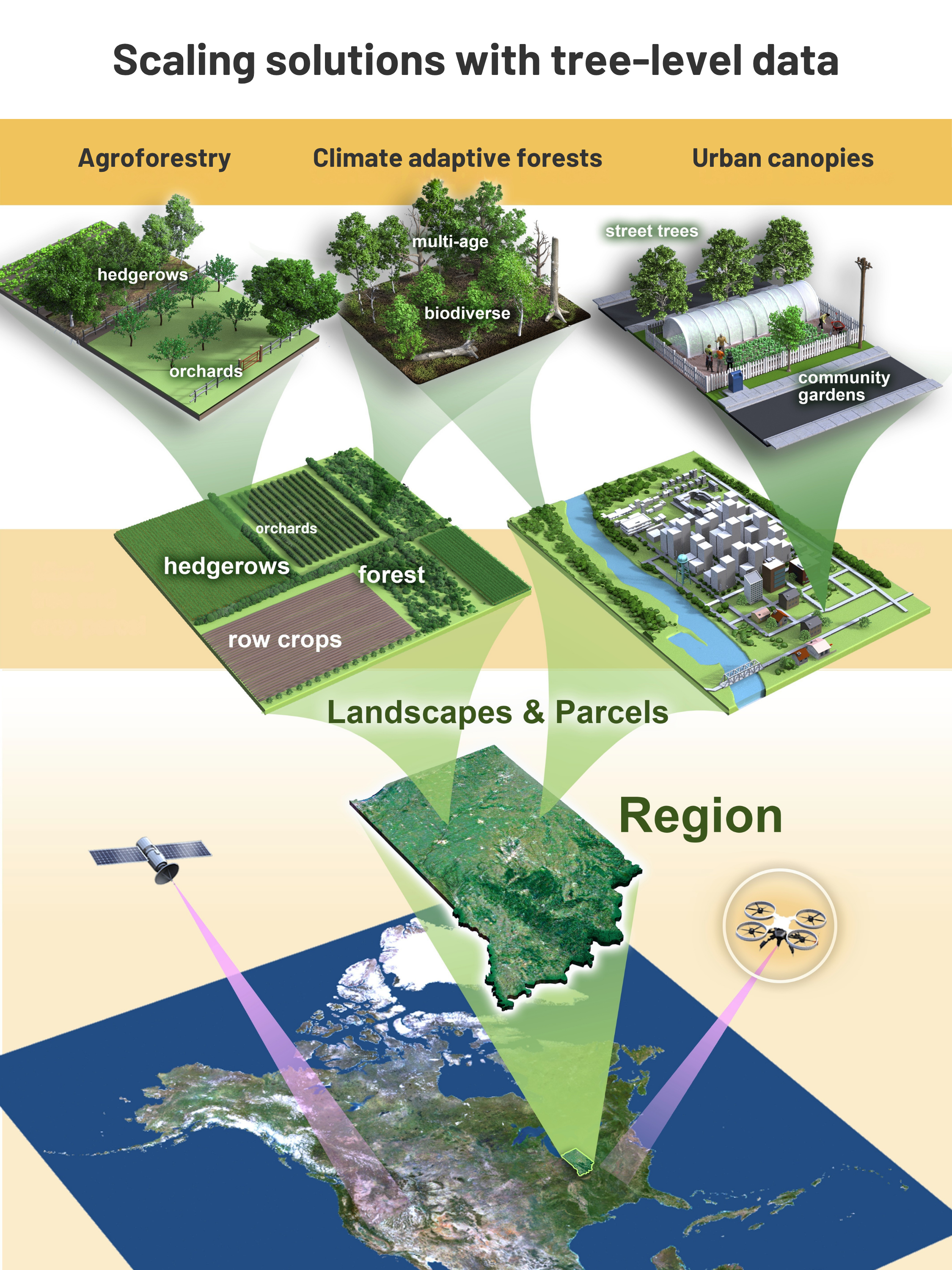
First, it changes the basic building block of accounting. Instead of starting with rigid "land-use" definitions, like a forest or farm, it starts at the level of an individual tree. This allows us to track trees and their benefits everywhere, from rural forests to urban landscapes.
Second, it’s an architectural shift. The old system is fragmented and static, like separate ledgers kept in isolated accounts (think of separate checking accounts between spouses). In contrast, the new system is an integrated, dynamic, and hybrid public-private ecosystem. A public backbone to the system would ensure trust and open standards, while a competitive private market can then advance innovation.
This tree-centric approach is more transparent and flexible, allowing us to account for carbon and other ecosystem services more holistically.
You propose a data system that is a “public-private infrastructure.” Can you elaborate?
This new system would work as a hybrid public-private ecosystem, much like our GPS or weather network.
The public sector's primary role is to serve as the trusted foundation, providing a stable "data highway" and setting open standards for components like APIs and data formats. Public agencies like USDA would create the permanent infrastructure that makes innovation possible.
Private companies can then compete on that highway, building apps, specialized models, “value-added” data, and user-friendly tools for landowners, investors, and communities.
You write that a tree-level data system might offer unexpected insights – identifying places where trees need to be removed or even disrupting the concept of a “forest” as we currently know it. How could the new framework create possibilities for economic value and ecological health?
This is a crucial point, as it gets to the heart of how this new architecture creates value. The old system, by focusing on coarse land-use definitions, is often a blunt instrument. A tree-centric system is a precision tool that unlocks new possibilities.
In terms of ecological health, the legacy accounting systems often incentivized "more trees" over "healthier trees." A granular, tree-level system allows us to move beyond just counting carbon so that we can start to better model and quantify resilience.
For example, in fire-prone areas like the western U.S., the system might reveal that strategically thinning a dense forest actually improves ecological health. It can show that "less forest is more" by reducing the risk of a catastrophic wildfire.
In terms of economic value, individual tree dMRV can help de-risk assets and empower new participants. The economic value of a forest carbon project is zero if it burns down. But by allowing managers to quantify resilience, the dMRV system helps "de-risks investment" for the long term. A healthy forest that can survive a fire is a much more secure and valuable asset.
The old system excluded millions of inherently valuable trees simply because they weren't in a "forest." A tree-centric system challenges that rigid definition, recognizing that a tree in an agroforestry system or an urban canopy provides real, quantifiable climate benefits. Tree-level accounting creates enormous economic value by empowering new groups, like farmers, ranchers, and city managers, to monetize their stewardship and participate in climate solutions for the first time.
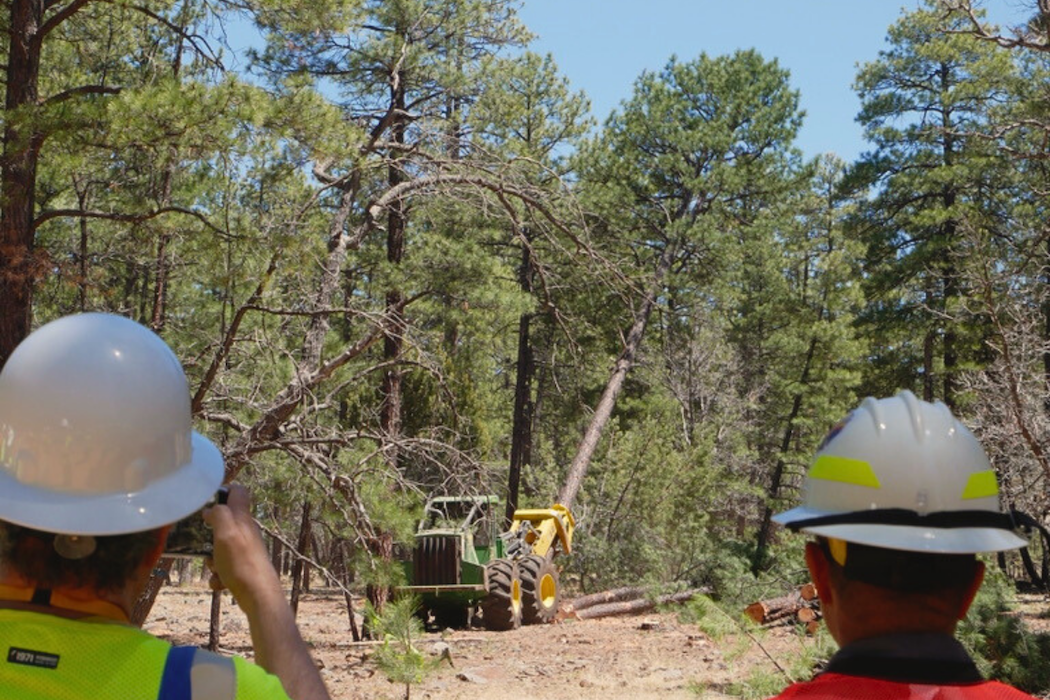
In Arizona's Coconino National Forest, a specialized machine thins trees to reduce wildfire risk and improve ecological health. Photo by Rachel Kovinsky
How do you see a tree-level digital MRV becoming a reality? What needs to be further developed?
The main challenge isn't the technology–it’s the architecture to connect it all.
Space-based LiDAR and high-resolution commercial satellites are already measuring the 3D structure and height of forests. We're using computer vision to delineate tree crowns, and AI to fuse sparse field data with continuous satellite imagery to estimate biomass. In the U.S., the USDA's Forest Inventory and Analysis program is an invaluable calibration and validation dataset that makes a tree-level data system feasible.
The biggest gaps for a tree-level data system are in governance, standardization, and integration. This is the core argument of my commentary. As I propose, we need a hybrid ecosystem with a public agency acting as the trusted backbone, guaranteeing open standards and foundational data layers. This doesn't exist yet in a formal way.
Another missing piece is standardization. Right now, the market is a Wild West of fragmented and often opaque MRV methodologies. This creates mistrust. We need to develop open-source, statistically rigorous methods that can combine different models into a single, robust, and trusted consensus estimate.
Policy and market rules have yet to catch up with the technology. Carbon market registries and policymakers need to formally adopt protocols that allow for dynamic, digital-first approaches.
Finally, while we can monitor individual trees in test sites, scaling that capability to every tree across the nation in near-real-time is the long-term R&D challenge. But we can start by building the architecture to integrate the data we already have, which is worlds beyond the legacy systems we're currently using.
To move our climate future forward, we must first go back: shifting our focus from the abstract 'forest' to the fundamental individual tree.


